
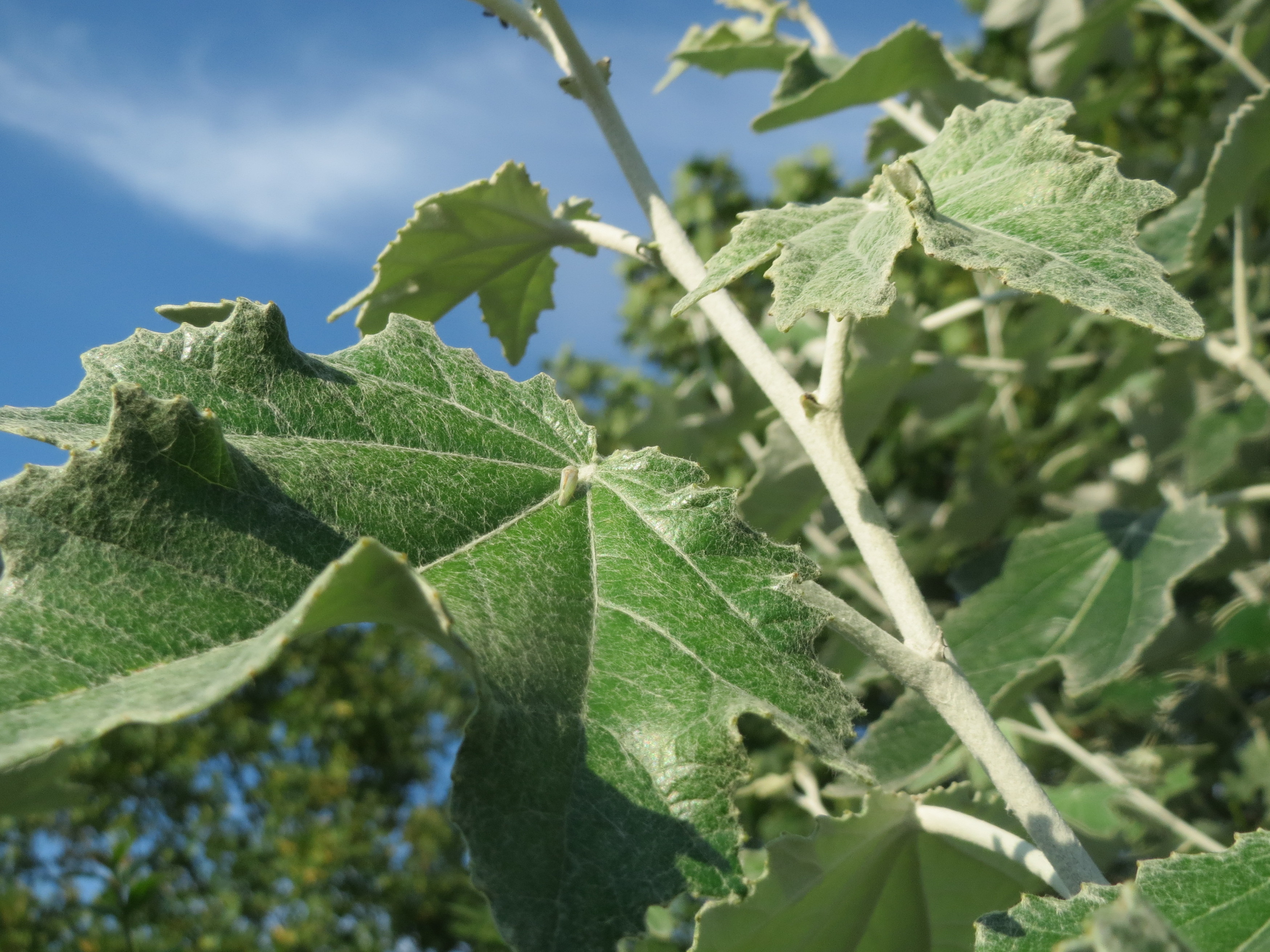

A tree whose leaves flash white on the underside in the wind, so the crown looks as if covered in snow from a distance
White poplar.

Nature · Trees
Long-naturalised introduction (non-native per Woodland Trust) · deciduous, to 20 m · wet ground, coasts
Populus alba — Salicaceae
The whitest tree in the landscape, white poplar has leaves densely felted white beneath so that a breeze turns the crown to silver. It is native to central and southern Europe and North Africa but has been in Britain long enough to be naturalised, often by water and on the coast. It suckers to form thickets.
A tree whose leaves flash white on the underside in the wind, so the crown looks as if covered in snow from a distance
White poplar.
Pale grey bark marked with black diamonds, twigs and buds covered in white hair
White poplar.
Consecrated to Hercules after he slew Cacus; sacrificers wore garlands of it
White poplar.
Planted as a windbreak on coasts because it tolerates sand and salt winds, and forms thickets by suckering
White poplar.
Historic documents refer to "Abel" trees, hinting at a long presence in Britain
White poplar.
Lobed leaves rather than the triangular ones of its native relative; buds hairy unlike other poplars
White poplar (Populus alba).