🪴 GoDeep
Search
← University Challenge
Portrait of Red oak

Nature · Trees

Red oak

Neophyte (North American) · deciduous to 25 m · parks, estates and plantations

Quercus rubra — Fagaceae

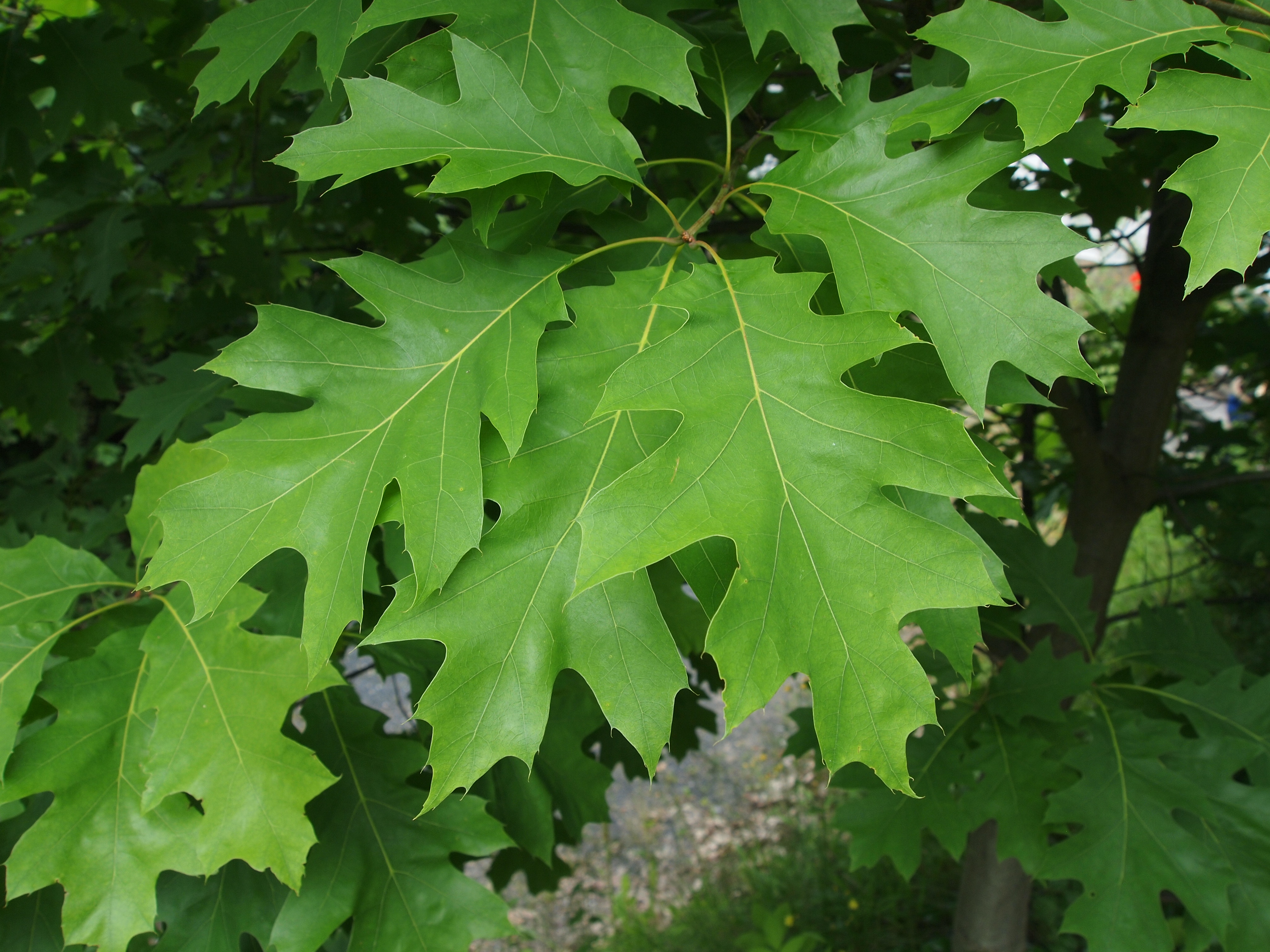
A North American oak planted in British parks for its blazing autumn colour, and used as a forest tree in Europe in the 19th century and in Britain after about 1920. It is easily separated from the native oaks by its large, pointed, whiskery leaf lobes. It is not considered invasive.

How to know it

Whole tree of Red oak
Whole tree Dietmar Rabich · CC BY-SA 4.0
Leaf of Red oak
Leaf Angela Huster · CC0
Bark of Red oak
Bark MONGO · Public domain

How to spot them

  • ▸Large leaves, often over 20 cm, with pointed lobes ending in one to three whiskery teeth — never rounded like native oaks
  • ▸Leaves fade to bright red in autumn and may be held into winter
  • ▸Smooth, silver-grey bark when young, developing warts or ridges with age
  • ▸Acorns in a shallow cup that take two years to ripen
  • ▸Winter buds long and tapering to a point, with more than three scales
  • ▸Look-alike: English oak has rounded lobes, almost no leaf stalk and acorns on long stalks.

How to know it

An oak with big leaves whose pointed, whiskery-tipped lobes turn brilliant red in autumn, planted from North America

Red oak.

It takes about twenty years before it flowers and another twenty before it gives a good crop of acorns

Red oak (Woodland Trust).

It is the state tree of New Jersey and the provincial tree of Prince Edward Island

Red oak.

Its acorns need two years to ripen in a shallow rounded cup

Red oak.

An introduced oak whose leaves can hang on into winter, and which may be attacked by oak processionary moth

Red oak.

Used as a forest tree in Britain after 1920, it outgrows native oaks on acid sandy loams

Red oak.

Quick-fire facts

  • •Quercus rubra — rubra means red, for the autumn foliage and reddish timber
  • •Native to eastern North America; a long-standing plantation species in the Netherlands, Belgium and northern France
  • •Woodland Trust: extensively used as a forest tree in Europe in the 19th century and in Britain after 1920
  • •Forest Research: about 852 ha in Britain, and it could do better in the drier south and east as the climate warms
  • •Timber not as strong as English or sessile oak; widely used for furniture and flooring in North America
  • •Woodland Trust: less susceptible than native oaks to pests and pathogens, but may be attacked by oak processionary moth
  • •Provincial tree of Prince Edward Island; state tree of New Jersey
  • •It requires full light and plenty of space

Drill it — 7 cards

1 / 7new card

Sources