

Smooth grey bark like elephant hide, and long slender copper-coloured buds held at an angle from the twig
Beech — Fagus sylvatica.

Nature · Trees
Deciduous · to 40 m · 250–350 years
Fagus sylvatica — Fagaceae
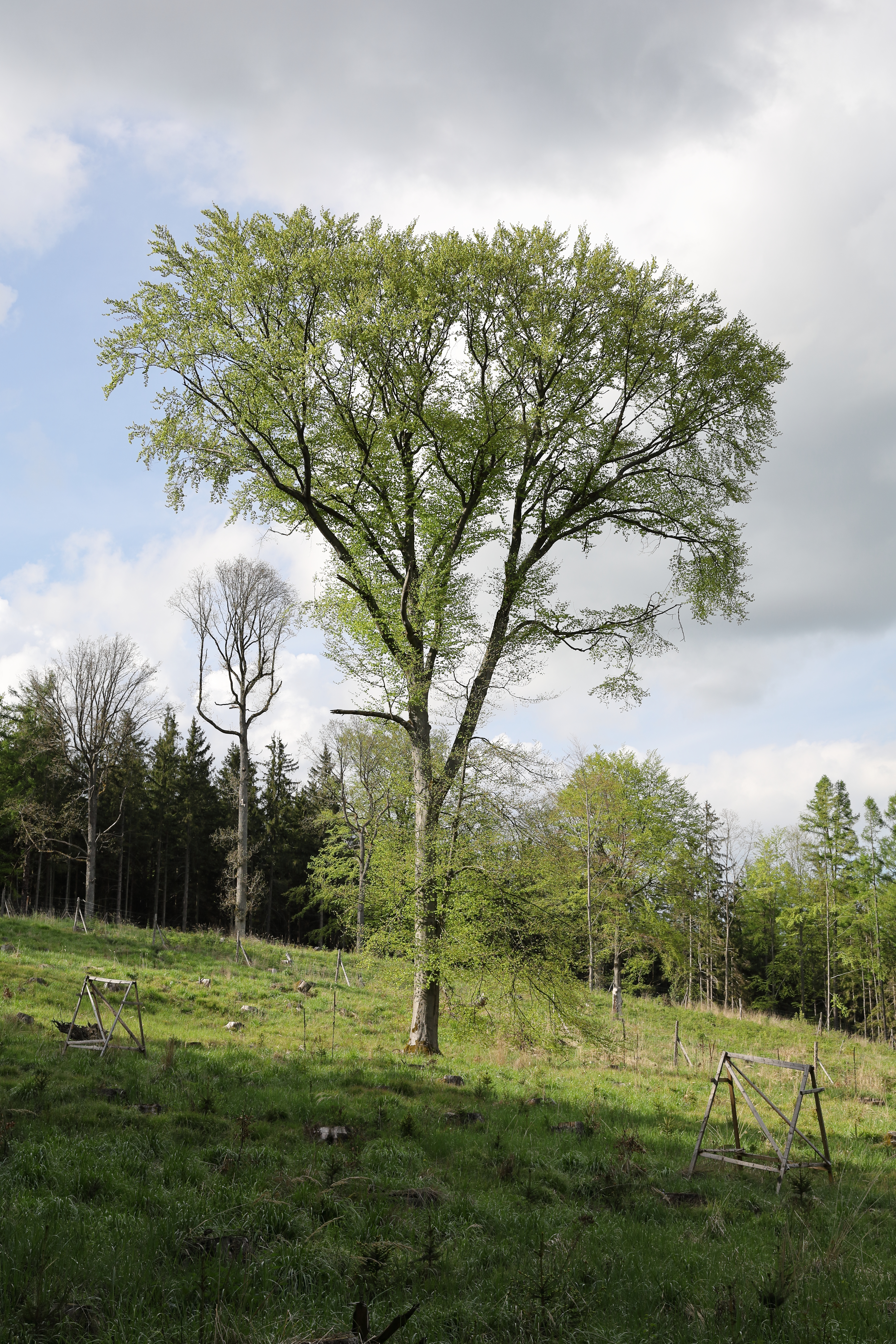
The beech is the queen of British trees to the oak's king: a smooth grey-barked giant casting such heavy shade that little grows beneath it but bluebells in spring. Truly native only to south-east England and south-east Wales, it is planted everywhere, and its habit of holding dead brown leaves through winter makes it the classic hedging tree.
Smooth grey bark like elephant hide, and long slender copper-coloured buds held at an angle from the twig
Beech — Fagus sylvatica.
Oval leaves with a wavy untoothed edge, fringed with silky hairs when they first open
Beech. Its hornbeam lookalike has sharply toothed, more deeply ribbed leaves.
Triangular nuts in pairs inside a soft, bristly four-lobed husk, once fed to pigs under the right of pannage
Beech mast.
Casts such heavy shade that little grows beneath it but bluebells; clipped hedges of it keep dead brown leaves all winter
Beech — the habit is called marcescence.
Its Latin genus name is thought to share a root with the word 'book', from runes cut into its wood
Beech — Fagus, and Old English boc.
Its timber turned the chair legs of the High Wycombe trade, made in the woods by itinerant craftsmen called bodgers
Beech.