
The Hunters in the Snow (1565)
Kunsthistorisches Museum, Vienna
Weary hunters and dogs look down on a frozen valley of skaters; one of his series of the months or seasons
Image: Pieter Brueghel the Elder · Public domain, Wikimedia Commons

Art
c. 1525–1569 · Flemish (Brabant, Habsburg Netherlands)
Northern Renaissance
Pieter Bruegel the Elder was the greatest Netherlandish painter of the sixteenth century, working in Antwerp and later Brussels. He turned landscape and scenes of peasant life into serious art, crowding his panels with detailed, often moralising observations of ordinary people. He founded a painting dynasty through his sons Pieter Brueghel the Younger and Jan Brueghel the Elder.
The Hunters in the Snow (1565)
Kunsthistorisches Museum, Vienna
Weary hunters and dogs look down on a frozen valley of skaters; one of his series of the months or seasons
Image: Pieter Brueghel the Elder · Public domain, Wikimedia Commons

Netherlandish Proverbs (1559)
Gemäldegalerie, Berlin
A village acting out around 100 Dutch proverbs literally; also called The Blue Cloak
Image: Pieter Brueghel the Elder · Public domain, Wikimedia Commons

The Tower of Babel (1563)
Kunsthistorisches Museum, Vienna
The 'Great' Tower, modelled on the Roman Colosseum; a smaller 'Little' Tower of Babel is in Rotterdam
Image: Pieter Brueghel the Elder · Public domain, Wikimedia Commons

The Peasant Wedding (1567)
Kunsthistorisches Museum, Vienna
Barn wedding feast with pies carried on a door taken off its hinges; the bride sits beneath a paper crown
Image: Pieter Brueghel the Elder · Public domain, Wikimedia Commons
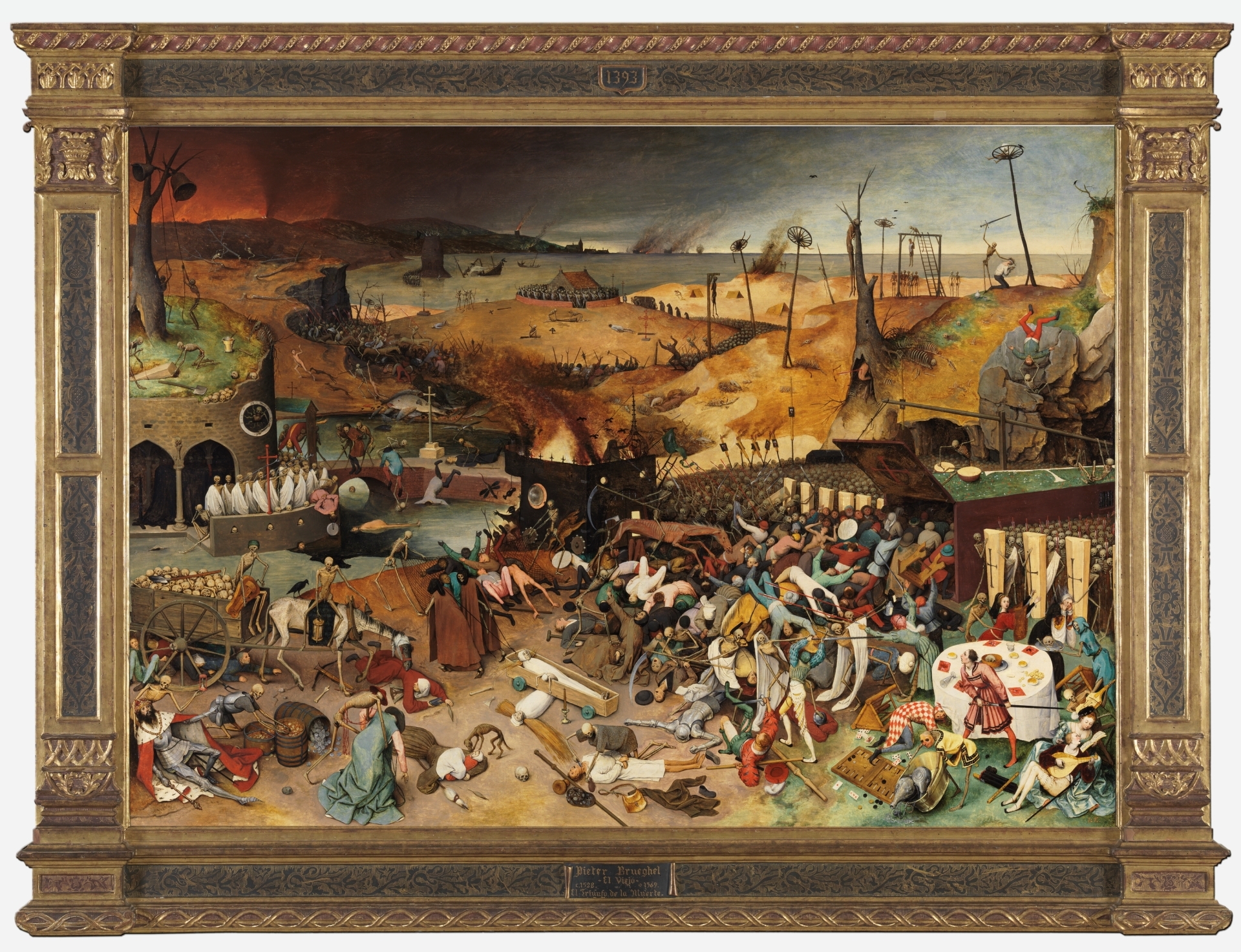
The Triumph of Death (c. 1562)
Museo del Prado, Madrid
Apocalyptic panorama of skeleton armies slaughtering the living, influenced by Hieronymus Bosch
Image: Pieter Brueghel the Elder · CC BY-SA 4.0, Wikimedia Commons

Landscape with the Fall of Icarus (c. 1560)
Royal Museums of Fine Arts of Belgium, Brussels
A ploughman ignores Icarus' legs splashing into the sea; now usually thought an early copy of a lost Bruegel
Image: After Pieter Brueghel the Elder · Public domain, Wikimedia Commons