Girl with a Pearl Earring (c. 1665)
Mauritshuis, The Hague
A tronie (not a portrait) of a girl in a blue and yellow turban glancing over her shoulder — the "Mona Lisa of the North"
Image: Johannes Vermeer · Public domain, Wikimedia Commons

Art
1632–1675 · Dutch
Dutch Golden Age / Baroque
Johannes Vermeer spent his whole life in Delft, producing only around 35 surviving paintings, mostly quiet domestic interiors of women reading, writing or working in soft daylight. Little known after his death, he was rediscovered in the 19th century and is now celebrated as a supreme master of light, colour and stillness.
Girl with a Pearl Earring (c. 1665)
Mauritshuis, The Hague
A tronie (not a portrait) of a girl in a blue and yellow turban glancing over her shoulder — the "Mona Lisa of the North"
Image: Johannes Vermeer · Public domain, Wikimedia Commons

View of Delft (c. 1660–1661)
Mauritshuis, The Hague
The town seen across the water; Proust's character Bergotte dies contemplating its "little patch of yellow wall"
Image: Johannes Vermeer · Public domain, Wikimedia Commons

The Milkmaid (c. 1660)
Rijksmuseum, Amsterdam
A kitchen maid pours a thin stream of milk into an earthenware bowl
Image: Johannes Vermeer · Public domain, Wikimedia Commons

The Art of Painting (c. 1666–1668)
Kunsthistorisches Museum, Vienna
An artist paints a model dressed as Clio, muse of history, before a map of the Netherlands; once owned by Hitler
Image: Johannes Vermeer · Public domain, Wikimedia Commons
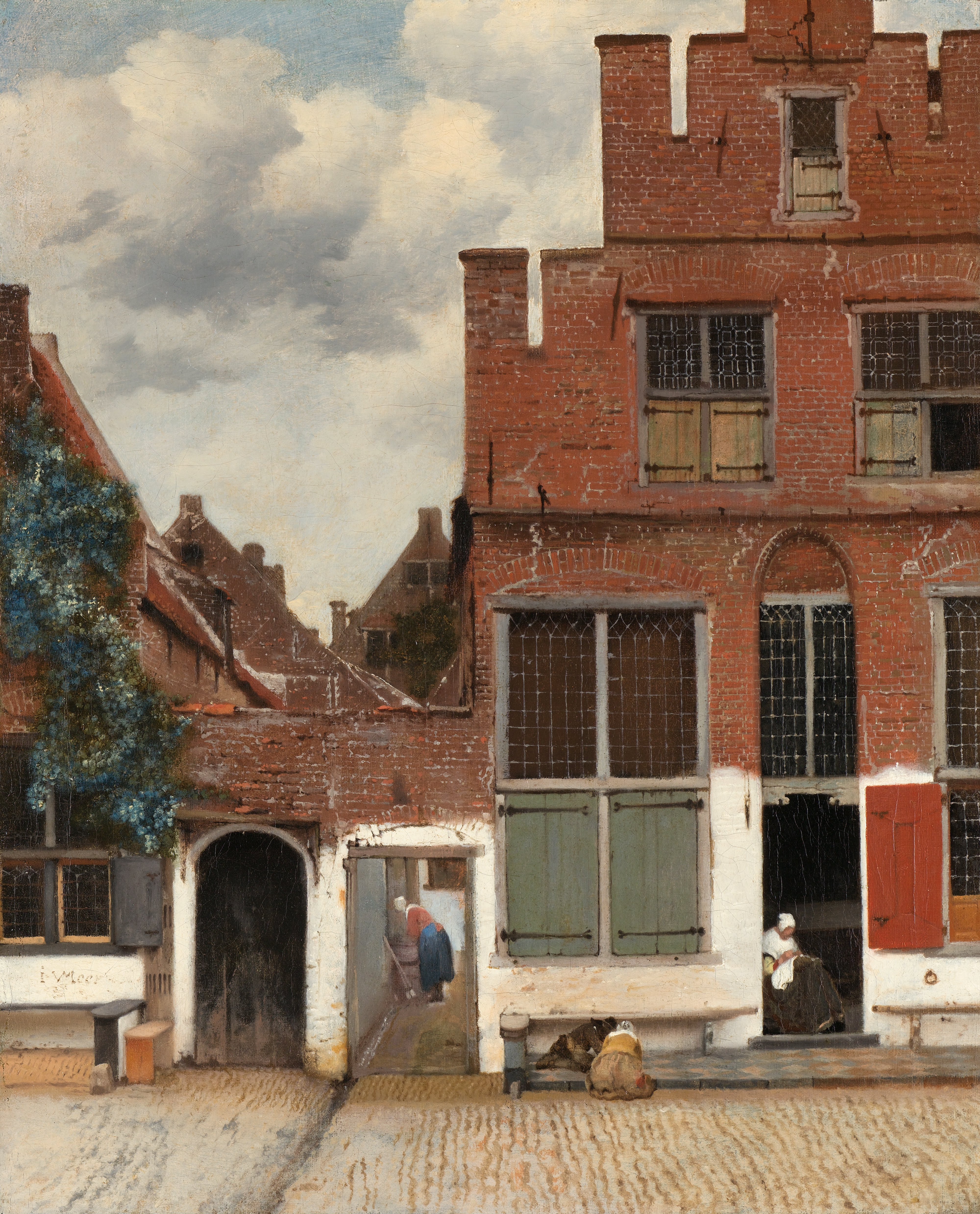
The Little Street (c. 1658)
Rijksmuseum, Amsterdam
Quiet brick house fronts in Delft; one of only two townscapes he painted
Image: Johannes Vermeer · Public domain, Wikimedia Commons

Woman Reading a Letter (c. 1663)
Rijksmuseum, Amsterdam
Also called Woman in Blue Reading a Letter; a pregnant-looking woman in a blue jacket before a map
Image: Johannes Vermeer · Public domain, Wikimedia Commons