🪴 GoDeep
Search
← University Challenge
Portrait of Henry Moore

Art · 20th century

Henry Moore

1898–1986 · English

Modernist sculpture — semi-abstract monumental bronze

Henry Moore was the sculptor who put semi-abstract bronze figures into public squares all over the world. A Yorkshire miner's son, he returned again and again to three subjects — the reclining figure, the mother and child, and the internal form inside an external one — and his shelter drawings of Londoners sleeping in the Tube made him a household name.

How to spot them

  • ▸A reclining female figure, limbs swelling into hills and hollows, usually in bronze and usually with a hole through the body
  • ▸Two- and three-piece figures split into separate mounds that read as landscape from a distance
  • ▸Mother-and-child groups, and 'internal/external' forms with one shape sheltering inside another
  • ▸Wartime drawings in wax crayon and wash of Londoners lying in rows in Underground tunnels

Key works

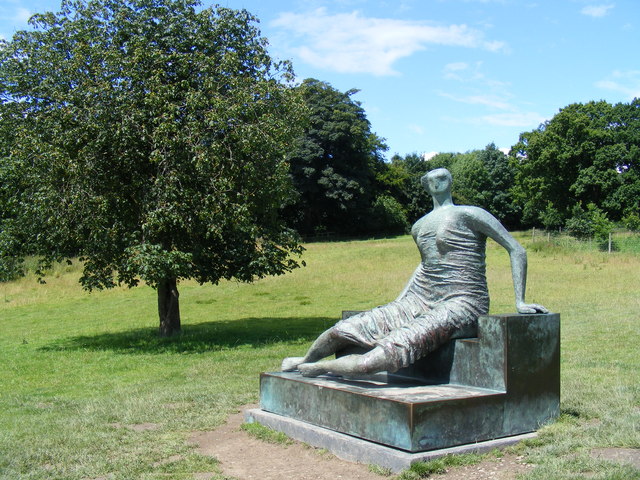
A two-piece bronze stolen by thieves with a crane from a Hertfordshire estate in 2005 and believed melted down for scrap by Henry Moore

A two-piece bronze stolen by thieves with a crane from a Hertfordshire estate in 2005 and believed melted down for scrap (1969)

Stolen from the Henry Moore Foundation, Perry Green, Hertfordshire

Taken in December 2005 on a stolen flatbed lorry; thought to have been cut up the same night

Image: Yair Haklai · CC BY-SA 3.0, Wikimedia Commons
A vast travertine figure carved for a Paris headquarters of a United Nations agency (1958)

UNESCO Headquarters, Paris

Carved from Roman travertine quarried at Querceta in Italy

No free image available (likely still in copyright) · see it on Wikipedia

A bronze woman known to Londoners as 'Old Flo', long sited on an East End housing estate and the subject of a bitter sale row by Henry Moore

A bronze woman known to Londoners as 'Old Flo', long sited on an East End housing estate and the subject of a bitter sale row (1958)

Cabot Square, Canary Wharf, London

Old Flo; Tower Hamlets tried to sell her in 2012, and a legal battle followed

Image: David Sands · CC BY-SA 2.0, Wikimedia Commons

A bronze in two halves that stands opposite the Houses of Parliament, the space between them as important as the metal by Henry Moore

A bronze in two halves that stands opposite the Houses of Parliament, the space between them as important as the metal (1965)

Abingdon Street Gardens, Westminster, London

Sometimes known as the Parliamentary sculpture

Image: Prioryman · CC BY-SA 4.0, Wikimedia Commons

A bronze dome, half skull and half mushroom cloud, marking the spot where the first self-sustaining nuclear chain reaction took place by Henry Moore

A bronze dome, half skull and half mushroom cloud, marking the spot where the first self-sustaining nuclear chain reaction took place (1967)

University of Chicago

Unveiled on 2 December 1967, 25 years to the minute after Fermi's Chicago Pile-1 went critical

Image: Just · Public domain, Wikimedia Commons

Two huge bronze forms leaning into each other so that visitors can walk between them by Henry Moore

Two huge bronze forms leaning into each other so that visitors can walk between them (1966)

Perry Green, Hertfordshire (versions elsewhere)

A cast stood outside the Serpentine Gallery in Kensington Gardens for many years

Image: Canmenwalker · CC BY 4.0, Wikimedia Commons

Drawings of rows of sleeping Londoners in tube tunnels, made as an official war artist (1941)

Tate and the Imperial War Museum, London

The Shelter Drawings, which made him famous with the wider public

No free image available (likely still in copyright) · see it on Wikipedia

Quick-fire facts

  • •Born in Castleford, Yorkshire, in 1898, the seventh of eight children of a coal miner; wounded by gas at Cambrai in the First World War
  • •Studied at Leeds School of Art with Barbara Hepworth, then at the Royal College of Art
  • •Deeply influenced by a cast of a Toltec-Maya Chacmool figure he saw in Paris, the origin of the reclining figure
  • •Appointed an official war artist in 1940; the shelter drawings made his reputation with the public
  • •Won the International Sculpture Prize at the Venice Biennale in 1948
  • •Refused a knighthood, saying it would make him seem an establishment figure, but accepted the Companion of Honour in 1955 and the Order of Merit in 1963
  • •Set up the Henry Moore Foundation at Perry Green, Hertfordshire, in 1977, giving away most of his fortune
  • •Reclining Figure 1969–70 was stolen from the Foundation in 2005 and has never been recovered
  • •Died at Perry Green in 1986; the Henry Moore Institute in Leeds opened in 1993

Drill it — 8 cards

1 / 8new card

Sources