The largest cell in the human body, just visible without a microscope, about a tenth of a millimetre across
Egg cell — the ovum.
Anatomy · Cells & tissues
The female gamete — the largest cell in the human body
Reproductive system · female germ cell
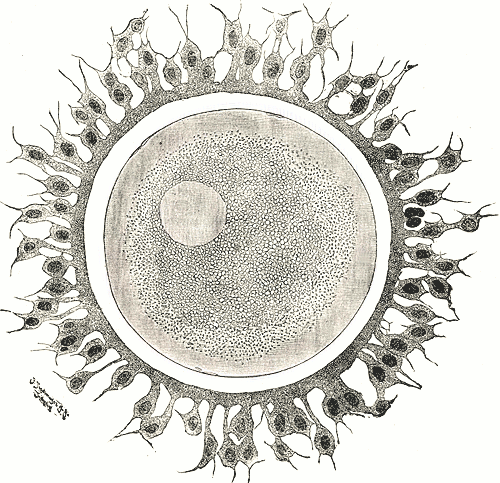
The female reproductive cell, or ovum: a large, round cell about 0.1 mm across, just visible to the naked eye as a speck. It is packed with cytoplasm and mitochondria that will sustain the early embryo, and it carries 23 chromosomes. It is wrapped in a clear glycoprotein coat, the zona pellucida, and surrounded by a halo of follicle cells, the corona radiata. Released from the ovary at ovulation, it survives for only about 12–24 hours unless it is fertilised.
The largest cell in the human body, just visible without a microscope, about a tenth of a millimetre across
Egg cell — the ovum.
A clear, glassy layer of glycoproteins that sperm must recognise and penetrate
Egg cell — the zona pellucida.
A halo of follicle cells that stays with it after ovulation
Egg cell — the corona radiata.
It is released from the ovary arrested part-way through its second meiotic division, and finishes only if a sperm enters
Egg cell — a secondary oocyte, arrested in metaphase II.
Tiny by-products of division that hold discarded chromosomes and almost no cytoplasm
Egg cell — the polar bodies.
Granules under its surface release their contents after a sperm enters, hardening the coat to stop a second one
Egg cell — the cortical reaction prevents polyspermy.
The German-Estonian scientist Karl Ernst von Baer first observed the mammalian version in 1827, in a dog's ovary (1827)
Egg cell — von Baer's discovery of the mammalian ovum.