🪴 GoDeep
Search
← University Challenge
Portrait of Laburnum

Nature · Trees

Laburnum

Neophyte (garden tree since the 16th century) · deciduous to 8 m · gardens, parks and roadsides

Laburnum anagyroides — Fabaceae

The golden chain tree of early summer: a small south European tree whose hanging yellow flower chains make it one of the best-loved garden trees in Britain. Every part of it is poisonous, above all the black seeds in pea-like pods, which contain the alkaloid cytisine. It occasionally self-sows but is not considered invasive.

How to know it

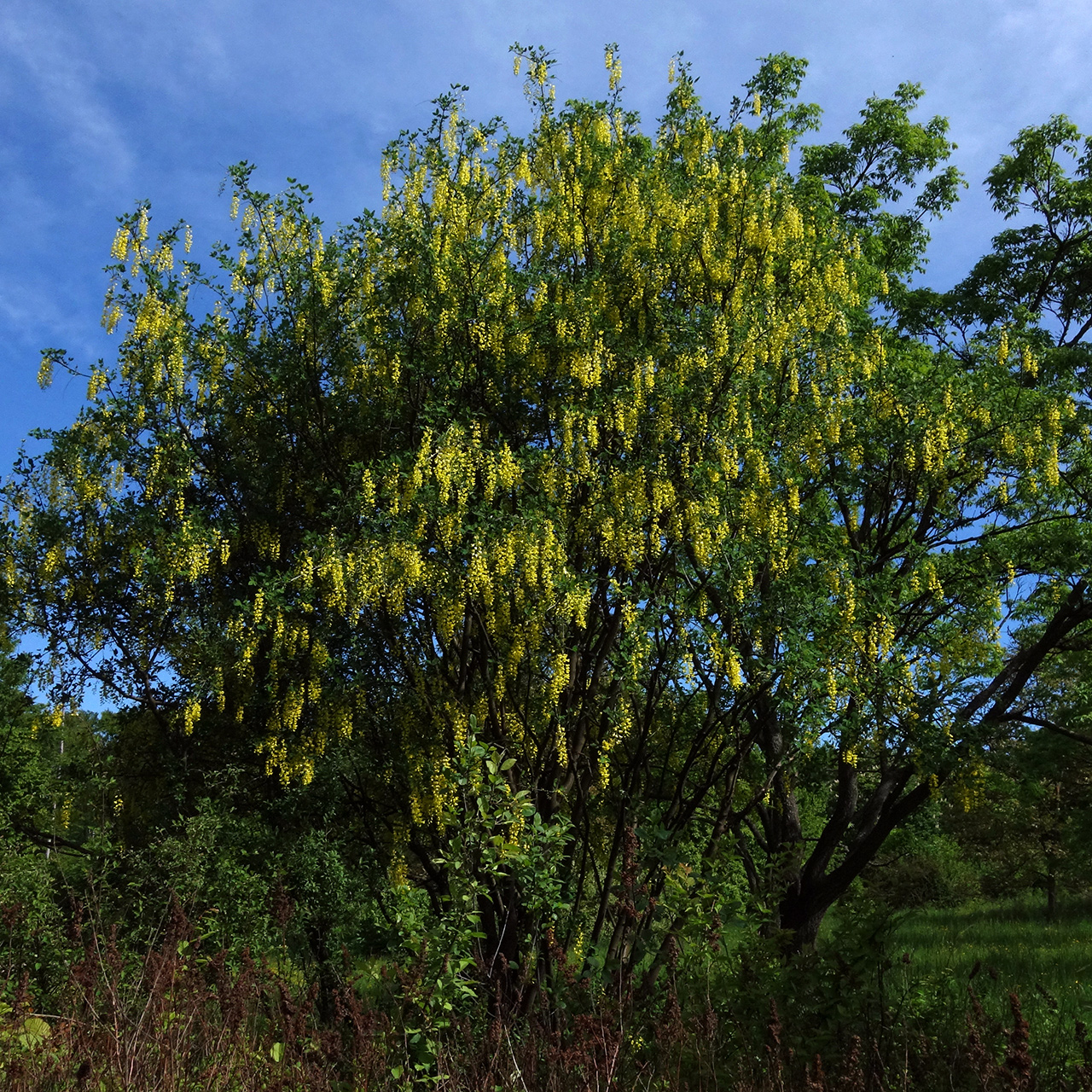
Whole tree of Laburnum
Whole tree Hladac · CC BY-SA 4.0
Leaf of Laburnum
Leaf Hladac · CC BY-SA 4.0
Bark of Laburnum
Bark Hladac · CC BY-SA 4.0

How to spot them

  • ▸Dense hanging chains (racemes) of golden-yellow pea flowers, late spring to early summer
  • ▸Leaves made of three oval leaflets (trifoliate), silky beneath
  • ▸Pods like flat, hairy peapods that ripen brown, with small black seeds
  • ▸Smooth, greenish-brown bark; a small, spreading tree
  • ▸Look-alike: wisteria is a climber with pinnate leaves and mauve chains; golden rain tree (Koelreuteria) has pinnate leaves and yellow panicles in July. Only laburnum has three-leaflet leaves.

How to know it

Its hanging chains of yellow pea flowers are a highlight of late spring, but the black seeds are poisonous

Laburnum.

Leaves made of three oval leaflets and pods full of black seeds that contain the alkaloid cytisine

Laburnum.

A famous 55-metre tunnel of it at Bodnant Garden in Wales is one of the spring sights of Britain

Laburnum.

Harmful if eaten, according to the RHS; every part of this garden tree is toxic

Laburnum.

A famous graft chimaera, Adam's version, blends this tree with a purple broom

Laburnum. +Laburnocytisus 'Adamii'.

Its dark heartwood has been used as a substitute for ebony

Laburnum.

Quick-fire facts

  • •Laburnum anagyroides — from the Latin laburnum for the tree; anagyroides means resembling Anagyris (a stinking Mediterranean shrub)
  • •Family Fabaceae; native to the mountains of southern and central Europe; not native to Britain and Ireland (RHS)
  • •All parts are poisonous; the seeds contain the alkaloid cytisine (RHS: harmful if eaten)
  • •Voss's laburnum (L. × watereri) is a hybrid of common and Scottish/alpine laburnum with longer chains and fewer seeds
  • •Adam's laburnum is a graft chimaera between laburnum and purple broom
  • •The Laburnum Arch at Bodnant Garden, Conwy, is a celebrated garden feature
  • •RHS: may be susceptible to powdery mildews, silver leaf and honey fungus; aphids and leaf-mining moths
  • •Not treated as invasive; occasional self-sown seedlings

Drill it — 7 cards

1 / 7new card

Sources