🪴 GoDeep
Search
← University Challenge
Portrait of Kakapo

Nature · Birds

Kakapo

Critically Endangered · 325 birds (DOC, September 2026)

Strigops habroptilus — Strigopidae

The kakapo is a huge, moss-green, flightless parrot from New Zealand, nocturnal, ground-dwelling and the heaviest parrot in the world. Males gather at hilltop bowls and boom through the night to attract females, the only lek mating system known in any parrot. Reduced to 51 known birds when the recovery programme began in 1995, every surviving individual lives on predator-free islands and carries a name and a transmitter.

How to spot them

  • ▸Mottled yellow-green plumage barred with black, superb camouflage against forest moss and lichen
  • ▸An owl-like facial disc of fine bristly feathers, hence the old name 'owl parrot'
  • ▸Very short, rounded wings used only for balance and parachuting down from trees; a broad, flat 'keel-less' sternum
  • ▸A low-frequency booming call, repeated 20–30 times, audible up to 5 km; followed by a metallic 'ching'
  • ▸A sweet, musty, honeyish smell — a liability, since it betrays the bird to introduced stoats, cats and rats

How to know it

The world's heaviest parrot: males reach about 4 kg, and it cannot fly at all

Kakapo — the only flightless parrot.
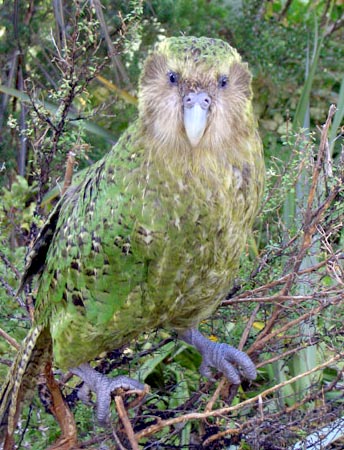
Males inflate a thoracic air sac and boom from a hilltop bowl; the only parrot with a lek

Kakapo booming, audible up to 5 km.

Breeding is tied to the mast fruiting of the rimu tree, so it may not nest for two or three years

Kakapo breeding is triggered by rimu mast years.

Its Maori name means 'night parrot'; the moss-green bird was once called the owl parrot

Kakapo (kākāpō).

A bird named Sirocco became New Zealand's 'official spokesbird for conservation' after a 2009 mishap on a BBC film shoot

The kakapo Sirocco, who attempted to mate with Mark Carwardine's head on Last Chance to See.

In 1995 just 51 were known, including only 20 females; by September 2026 the count stood at 325

Kakapo Recovery Programme, Department of Conservation.

Every living bird is individually named and radio-tagged on predator-free islands such as Whenua Hou and Anchor Island

Kakapo — intensively managed conservation.

Quick-fire facts

  • •Strigops habroptilus means roughly 'owl-face, soft-feathered'; it is the only species in its genus
  • •Believed to be the longest-lived bird of any: individuals may reach 60 years or more, with some estimates of 90
  • •Herbivorous — leaves, buds, roots, rhizomes and fruit, especially rimu; it chews foliage and leaves fibrous 'chews' behind
  • •The Department of Conservation counted 325 birds on 1 September 2026, when 90 chicks from the 2026 season reached 150 days; the highest total in perhaps 75 years
  • •The 1995 recovery programme started from 51 known birds; the whole species went through a genetic bottleneck of a few dozen
  • •Richard Henry, a male translocated from Fiordland in 1975 and believed over 80 when he died in 2010, carried mainland genes found in no other living bird
  • •The 2019 season produced a then-record 71 fledglings; aspergillosis killed several chicks that year
  • •Sperm is sometimes delivered by drone between islands, and artificial insemination has been used to widen the gene pool
  • •IUCN Red List: Critically Endangered

Drill it — 8 cards

1 / 8new card

Sources