🪴 GoDeep
Search
← University Challenge
Portrait of Holm oak

Nature · Trees

Holm oak

Neophyte (introduced late 1500s) · evergreen to 20 m · coasts, parks and gardens in the south

Quercus ilex — Fagaceae

An evergreen oak from the Mediterranean, brought to Britain in the late 1500s and now a familiar dark, dome-crowned tree of southern coasts, churchyards and parks. Its glossy, holly-like young leaves earn it the alternative name holly oak, and it shrugs off salt spray better than almost any native tree. It is naturalised in the south but is not regarded as a serious invader.

How to know it

Whole tree of Holm oak
Whole tree Alfonso San Miguel · CC BY-SA 4.0
Leaf of Holm oak
Leaf Ranko · CC BY-SA 3.0
Bark of Holm oak
Bark Agnieszka Kwiecień, Nova · CC BY-SA 4.0

How to spot them

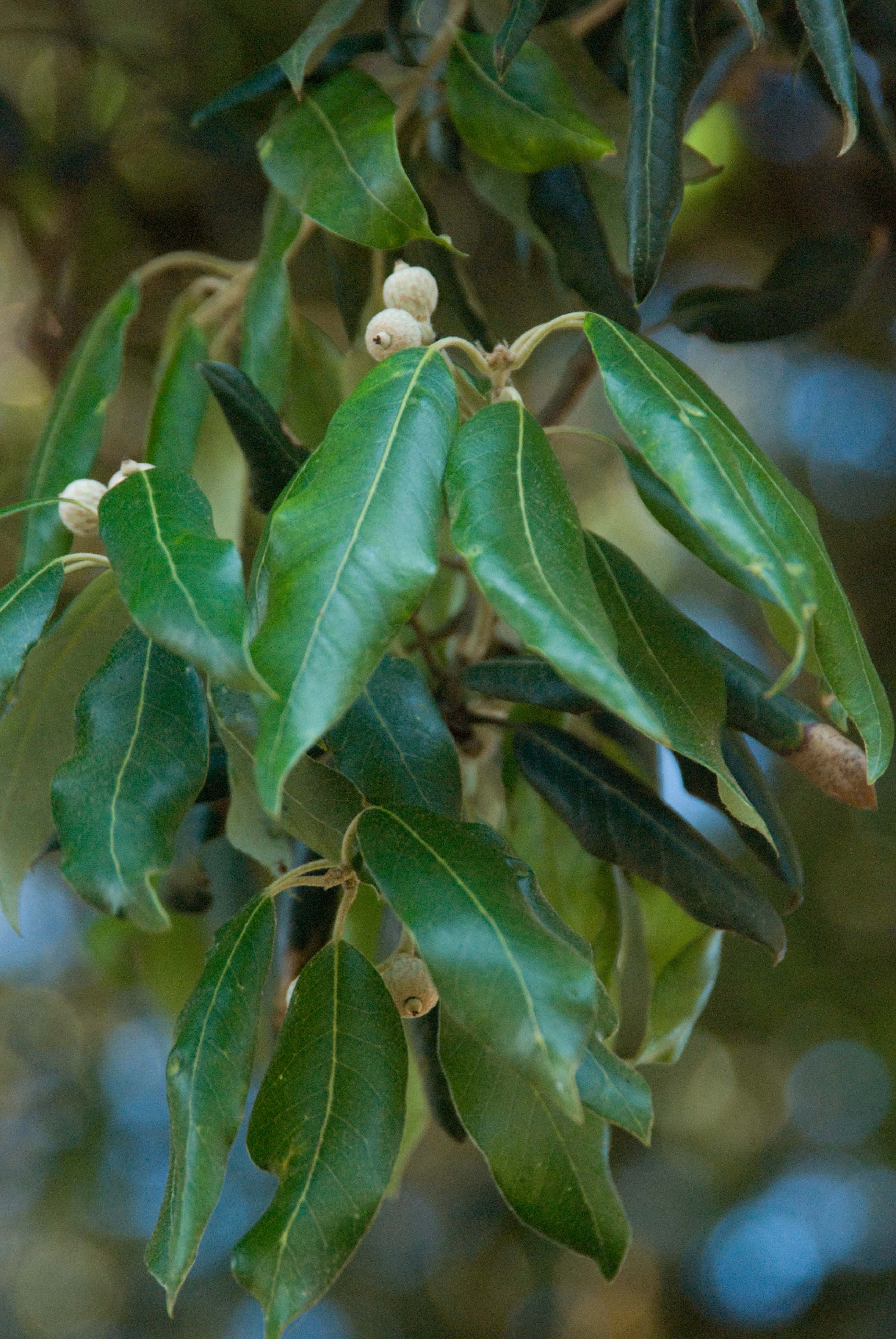
  • ▸Evergreen oak: leathery, unlobed, oval leaves, dark and glossy above, with a pale grey felt of hairs beneath
  • ▸Young leaves and sucker shoots are spiny-toothed like holly; older leaves are smooth-edged
  • ▸Black, finely cracked bark, and twigs covered in pale brown felt
  • ▸Small acorns with a more pointed tip than English oak, in a cup of tight, grey, downy scales
  • ▸Look-alike: holly (Ilex) has glossy spiny leaves but no grey felt beneath, red berries not acorns, and smooth grey bark. Native oaks are deciduous with lobed leaves.

How to know it

The only common evergreen oak in Britain, its leathery leaves are dark above and covered in pale grey felt below

Holm oak.

Young leaves of this oak are spiny like a holly, while the older leaves on the same tree are smooth-edged

Holm oak. The specific epithet ilex is the Latin name of this oak, and the holly genus Ilex borrows it.

A Mediterranean oak brought to Britain in the late 1500s that now shelters seaside towns as a windbreak, tolerating salt spray

Holm oak.

Its acorns are fed to the black Iberian pigs that produce a famous Spanish cured ham

Holm oak (with cork oak).

In ancient Greece the leaves of this evergreen oak were used to foretell the future and to make honorary crowns

Holm oak.

A severe winter can strip its leaves or kill it in Britain, which is why it is commoner in the south than the north

Holm oak.

Quick-fire facts

  • •Quercus ilex — ilex is the classical Latin name for this oak; the holly genus Ilex borrows it because of the leaf resemblance
  • •Holm derives from an Old English word for holly, hence the alternative name holly oak
  • •Introduced to Britain in the late 1500s (Woodland Trust); native to the Mediterranean
  • •Naturalised in southern England; not treated as an invasive species
  • •Tolerates salt spray, shade and air pollution, so it is planted as a coastal windbreak and street tree
  • •Woodland Trust: may be susceptible to acute oak decline and chronic oak decline, though less than English and sessile oak
  • •Not as valuable to wildlife as native oaks, but the dense evergreen canopy shelters birds and the catkins give bees pollen
  • •The timber is very hard and dense; the Romans used it for cart wheels and tools

Drill it — 7 cards

1 / 7new card

Sources