🪴 GoDeep
Search
← University Challenge
Portrait of Grey willow

Nature · Shrubs

Grey willow

Native · deciduous, to 10 m · catkins Mar–Apr · wet woodland, fen, ditches

Salix cinerea — Salicaceae

Grey willow is a common shrub or small tree of wet ground, fen carr, ditches and lake shores, one of the two broad-leaved willows collectively called sallows. It is easily muddled with goat willow, with which it hybridises freely, and is a standard example of the difficulty of British willow identification. The British plant is mostly subspecies oleifolia, the rusty willow, named for the rusty hairs under its leaves.

How to spot them

  • ▸Oval, blunt-tipped leaves at least twice as long as wide, grey felted beneath with rusty hairs along the veins
  • ▸Dark grey-brown bark with diamond-shaped fissures; young twigs grey-hairy, becoming smooth and sometimes red-yellow in sun
  • ▸Stout, oval grey male catkins that turn yellow with pollen in March and April, on bare twigs
  • ▸Wet woodland, fen carr, ditches, canals and damp ground, generally shrubby
  • ▸Look-alike: goat willow has broader, rounder leaves, only about twice as long as wide, with a twisted tip; the two hybridise, and intermediates are common

How to know it

A shrubby willow of wet ground whose oval leaves, about twice as long as wide, are felted grey beneath with rusty hairs along the veins

Grey willow — Salix cinerea subsp. oleifolia.
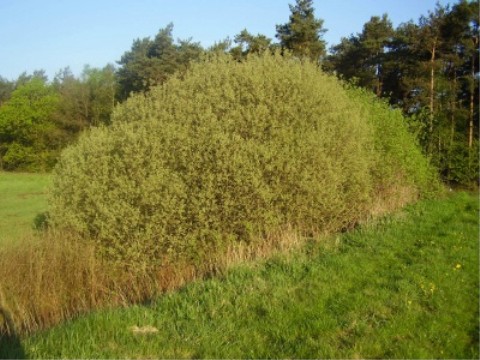
One of two broad-leaved willows called sallows; the two hybridise freely and confuse recorders

Grey willow, easily muddled with goat willow.

Its usual British subspecies is called the rusty willow, from the colour of the hairs on its leaf undersides

Grey willow — subsp. oleifolia.

Stout grey catkins turn yellow with pollen on bare twigs in early spring, and the plant is dioecious

Grey willow.

Its hybrid with goat willow bears the name Salix × reichardtii and is probably under-recorded

Grey willow × goat willow.

A common willow of ditches, reedbeds and wet woodland, with silver fluffy catkins

Grey willow — Salix cinerea.

Quick-fire facts

  • •Salix cinerea, family Salicaceae; the common British plant is subsp. oleifolia, the rusty willow (Woodland Trust; BSBI)
  • •Grows to about 10 m; bark grey-brown with diamond fissures (Woodland Trust)
  • •Leaves oval rather than long and thin, but at least twice as long as wide; silver felt beneath with rusty hairs along the veins (Woodland Trust)
  • •Dioecious: male catkins grey, stout and oval, turning yellow with pollen; female catkins longer and green (Woodland Trust)
  • •Peel the bark from a two-year twig: grey willow's wood carries long, thin, parallel raised ridges (striae, about 2–3 cm), whereas goat willow's is smooth — beware short 'false striae' beside leaf-scar pegs, which occur in both (BSBI hybrid willow guide)
  • •Hybridises with goat willow to form an unbroken series of intermediates, S. × reichardtii (BSBI)
  • •Native and common in Britain and Ireland, in wet ground, lake shores, thickets and woodland margins (BSBI)
  • •Reliable willow tests: is the leaf long and narrow or broad; is the underside silky-silver, grey felt or green; do the catkins come before, with or after the leaves; and are there ear-like stipules at the leaf base
  • •BSBI advises collecting foliage from July to September, and avoiding sucker shoots and shade leaves

Drill it — 6 cards

1 / 6new card

Sources