
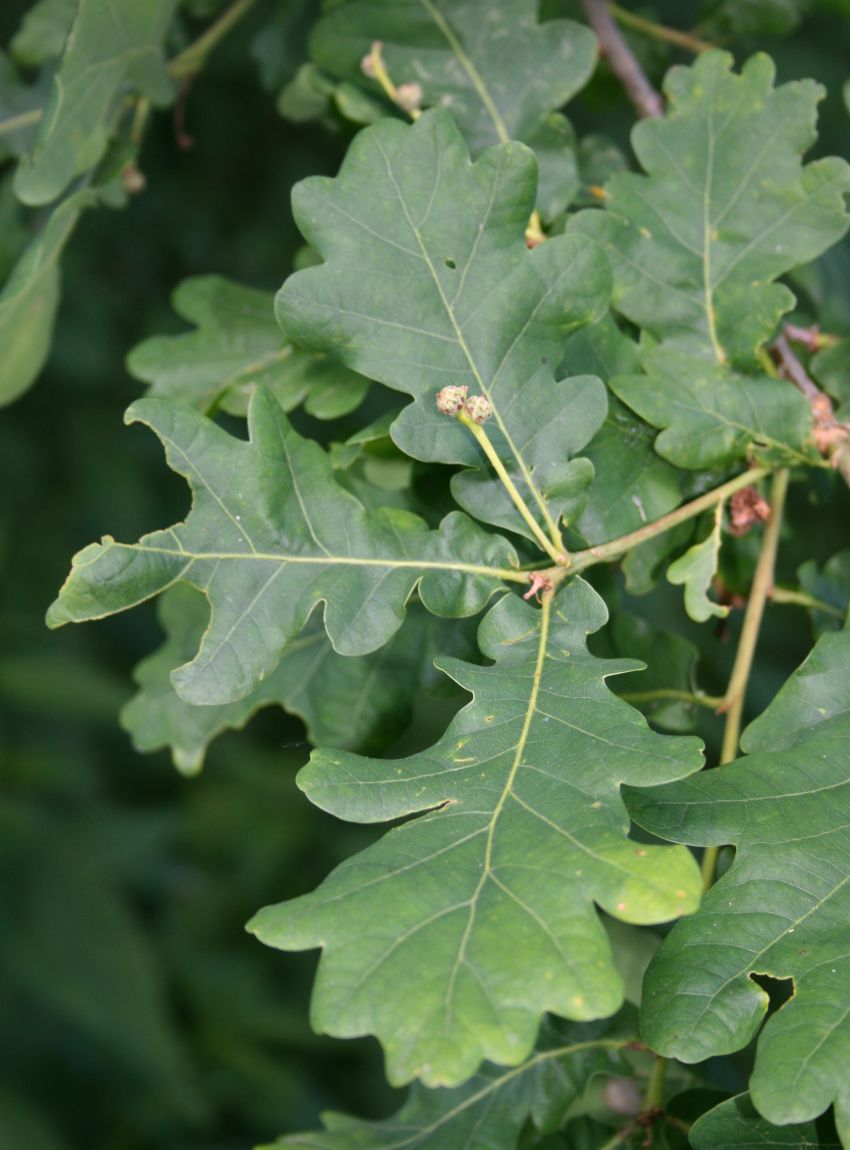

Leaves with four or five deep rounded lobes on almost no stalk, with two small ear-like flaps clasping the twig
English oak — Quercus robur, the pedunculate species.

Nature · Trees
Deciduous · to 20–40 m · often 500+ years
Quercus robur — Fagaceae
The pedunculate or English oak is the broadleaf most people picture when they think of a British tree: a broad, heavy-limbed giant of parkland, hedgerow and lowland wood. Its leaves are deeply lobed and almost stalkless, while its acorns hang on long stalks — exactly the reverse of the sessile oak. The Woodland Trust reckons oaks in the UK support more than 2,300 associated species, more than any other native tree.
Leaves with four or five deep rounded lobes on almost no stalk, with two small ear-like flaps clasping the twig
English oak — Quercus robur, the pedunculate species.
Fruit borne in ones to threes on a long stalk while the leaves have none — the exact reverse of its closest British relative
English oak. The long peduncle is why it is also called the pedunculate oak.
Bunched blunt buds at the twig tip, deeply ridged grey-brown bark, and a broad crown of heavy twisting limbs
English oak.
Sacred to Zeus, Jupiter and the Celtic Dagda; its bark tanned leather from Roman times and its timber built the Navy's ships of the line
English oak — 'Hearts of Oak'.
Knopper galls deform its fruit and hard brown marble galls stud its twigs, each grown by a tiny wasp
English oak. The knopper gall wasp, Andricus quercuscalicis, reached Britain in the 1960s.
A hollow, scaffolded giant in Sherwood Forest is Britain's most famous individual of this species
English oak — the Major Oak.
Its specific epithet is the Latin word for strength or hardwood, and gives us 'robust'
English oak — Quercus robur.