🪴 GoDeep
Search
← University Challenge
Portrait of Coast redwood

Nature · Trees

Coast redwood

Neophyte (introduced 1843) · evergreen conifer, the world's tallest tree · estates, arboreta and plantations

Sequoia sempervirens — Cupressaceae

The world's tallest tree, regularly topping 110 m in California, grows well in the milder, wetter west of Britain, where it was introduced in 1843. It grows fast and yields high-quality timber. It is easily confused with the giant sequoia, known in Britain as Wellingtonia, introduced ten years later. It is listed as Endangered by the IUCN.

How to know it

Whole tree of Coast redwood
Whole tree Robin Webster · CC BY-SA 2.0
Leaf of Coast redwood
Leaf Ilya Katsnelson from Mountain View, USA · CC BY 2.0
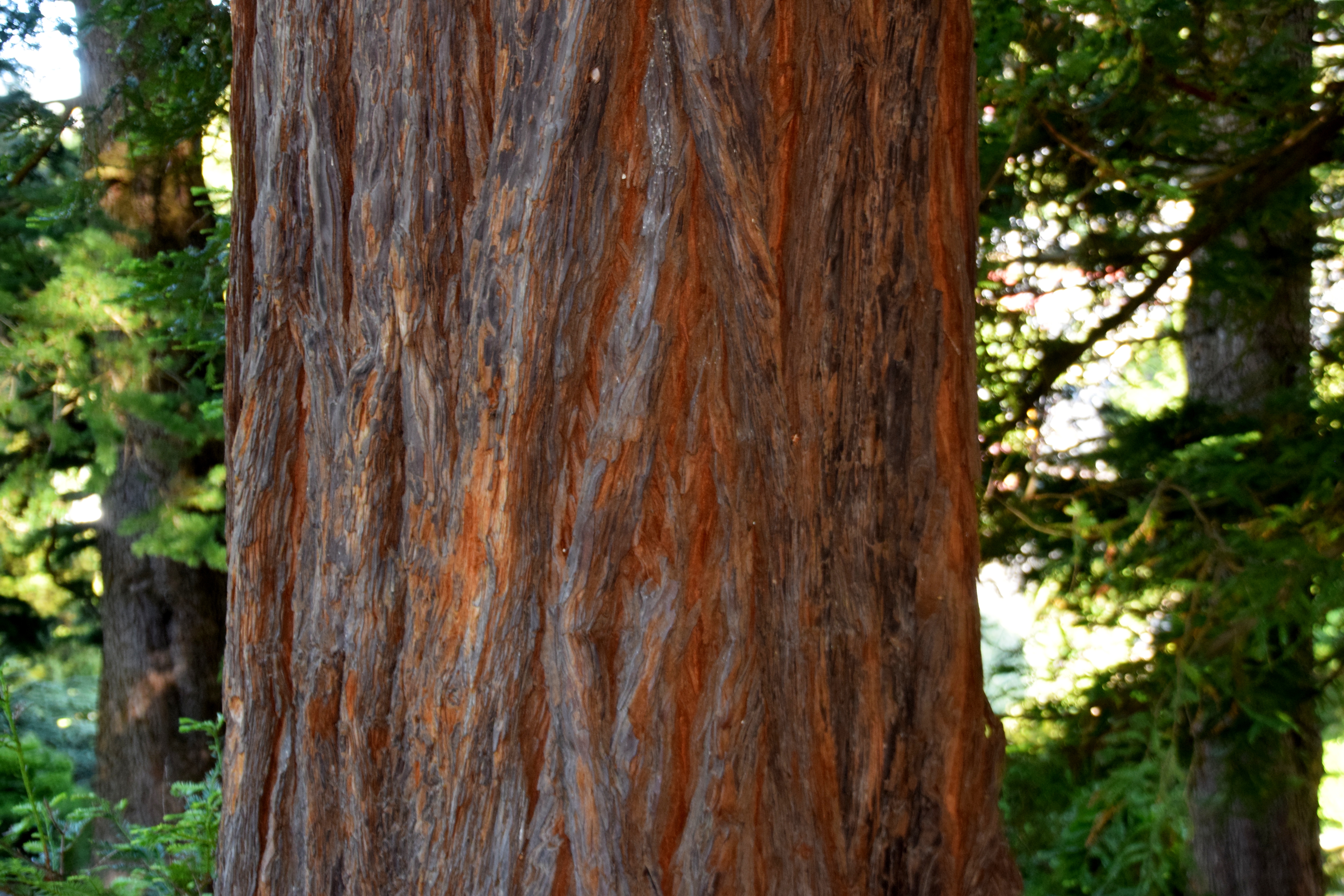
Bark of Coast redwood
Bark Krzysztof Golik · CC BY-SA 4.0

How to spot them

  • ▸Soft, flat, yew-like needles held in two rows along the twig, dark green above with white bands beneath
  • ▸Thick, soft, fibrous, red-brown, deeply furrowed bark
  • ▸Small, egg-shaped cones only 2 to 3 cm long
  • ▸Shoots readily sprout from the stump and base of a felled tree
  • ▸Tall, narrow, columnar trunk in a plantation grove
  • ▸Look-alike: giant sequoia (Wellingtonia) has short, sharp, scale-like awl leaves pressed to the twig, spongy bark, larger cones 5 to 8 cm and a massively buttressed trunk; coast redwood has flat, two-ranked needles.

How to know it

The tallest tree species on Earth, it regularly tops 110 metres in the fog belt of California

Coast redwood.

Introduced to England in 1843, it is the shorter-cone relative of a species named after the Duke of Wellington ten years later

Coast redwood, versus Wellingtonia (giant sequoia, 1853).

Its flat needles lie in two ranks like a yew's, and its thick red bark is soft and fibrous

Coast redwood.

A grove at Leighton near Welshpool, planted in 1856, is celebrated as the finest in Britain

Coast redwood.

It resprouts from the stump of a cut tree, unlike most conifers

Coast redwood (Forest Research).

Listed as Endangered by the IUCN, though widely grown in Britain in milder wetter western districts

Coast redwood.

Quick-fire facts

  • •Sequoia sempervirens — sempervirens means evergreen (literally ever-living); Sequoia is usually said to honour Sequoyah, the Cherokee scholar
  • •Introduced to England in 1843 (Woodland Heritage); the giant sequoia, Sequoiadendron giganteum, followed in 1853 and was named Wellingtonia after the Duke of Wellington, who had died in 1852
  • •World's tallest tree, regularly above 110 m (Forest Research); IUCN Endangered
  • •Best suited to Wales and south-west England with over 1,250 mm of rain; sensitive to late frost and exposure
  • •Regenerates from seed or from sprouts on cut stumps
  • •The Leighton Redwoods, Welshpool, planted in 1856, have been called the finest grove in Britain; Forest Research says one Leighton stand has the highest standing volume of any plantation in Britain
  • •Not invasive in Britain
  • •No notifiable pest specific to it; frost, wind and drought are the main dangers

Drill it — 7 cards

1 / 7new card

Sources