Nitrogen and hydrogen combined over a promoted iron catalyst at about 450 °C and 200 atmospheres
N2 + 3H2 ⇌ 2NH3, exothermic at about −92 kJ per mole of nitrogen.
Science · Chemistry
1909 (laboratory); 1913 (first industrial plant, at Oppau)
Chemistry — industrial catalysis
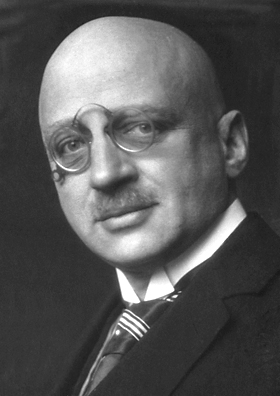
The Haber process fixes nitrogen from the air as ammonia: nitrogen and hydrogen are passed over an iron catalyst at roughly 400–500 °C and 150–250 atmospheres, and the ammonia is condensed out while the unreacted gases are recycled. Fritz Haber demonstrated it on a bench in 1909 with Robert Le Rossignol; Carl Bosch turned it into industrial plant for BASF, which began production at Oppau in 1913. It is arguably the most consequential chemical process ever devised. Synthetic fertiliser made from its ammonia now supports roughly half the world's population — and the same ammonia, oxidised to nitric acid, gave Germany the explosives to continue the First World War after the Allied blockade cut off Chilean nitrate.
Nitrogen and hydrogen combined over a promoted iron catalyst at about 450 °C and 200 atmospheres
N2 + 3H2 ⇌ 2NH3, exothermic at about −92 kJ per mole of nitrogen.
Often called 'bread from air': the reaction that makes ammonia on an industrial scale
The nitrogen is simply taken from the atmosphere, which is 78 per cent N2.
Roughly half the nitrogen atoms in your body were fixed by this reaction rather than by bacteria
Vaclav Smil's estimate; without it the planet could feed perhaps three to four billion people.
Carl Bosch engineered it up to industrial scale for BASF at Oppau in 1913, and won his own Nobel Prize in 1931 (1913)
The real difficulty was metallurgical: steel vessels that would not be embrittled by hot hydrogen at 200 atmospheres.
By making explosives from air, it let Germany fight on after the Allied blockade cut off Chilean nitrate
Ammonia oxidised to nitric acid, and nitric acid to TNT and other propellants.
Consumes something like one to two per cent of the world's entire energy supply
Most of it goes into making the hydrogen from natural gas by steam reforming, which is also why the process is a large source of carbon dioxide.
Its inventor, who also directed Germany's chlorine gas programme, was given the 1918 Nobel Prize in Chemistry for it (1918)
Announced in 1919 and bitterly contested by scientists in the Allied countries.