The 1974 Eurovision Song Contest winner at Brighton, named after a Belgian battlefield (1974)
"Waterloo" — later voted the best song in the contest's history at its fiftieth anniversary.
Popular music · Pop
1972–1982; reunited 2018– · Swedish
Europop — Polar Music, Stockholm
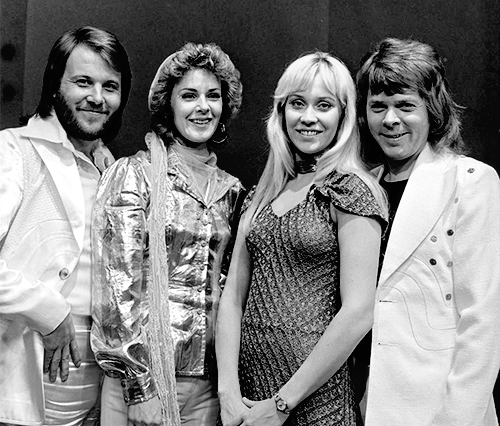
ABBA were a Swedish quartet of two couples — Agnetha Fältskog and Björn Ulvaeus, Anni-Frid "Frida" Lyngstad and Benny Andersson — whose Eurovision win in 1974 launched a decade of meticulously produced, melancholy-tinged pop. Björn and Benny wrote and produced; the two women sang the leads in close harmony. They stopped in 1982 without ever formally splitting, were revived commercially by the musical Mamma Mia!, and returned in 2021 with a new album and a London show performed by digital avatars.
The 1974 Eurovision Song Contest winner at Brighton, named after a Belgian battlefield (1974)
"Waterloo" — later voted the best song in the contest's history at its fiftieth anniversary.
A 1976 single about a seventeen-year-old having the time of her life at the disco, and their only US number one (1976)
"Dancing Queen" — premiered at the gala before the wedding of King Carl XVI Gustaf.
A 1980 ballad about a marriage ending, written by her ex-husband and sung by Agnetha (1980)
"The Winner Takes It All".
A 1979 disco single about a woman alone after midnight, later cleared as the hook of a Madonna hit (1979)
"Gimme! Gimme! Gimme! (A Man After Midnight)", sampled on Madonna's "Hung Up".
A 1980 song sung by a touring performer under the spotlight, longing for a letter from home (1980)
"Super Trouper" — named after a brand of follow-spot lamp.
A 1999 West End musical built from their back catalogue and set on a Greek island (1999)
Mamma Mia!, filmed in 2008 with Meryl Streep.
A 2021 album, their first in forty years (2021)
Voyage.
A London arena show from 2022 in which digital avatars of the band perform with a live band (2022)
ABBA Voyage, at the purpose-built ABBA Arena in the Queen Elizabeth Olympic Park.