'Hath not a Jew eyes? Hath not a Jew hands, organs, dimensions, senses, affections, passions?'
Shylock's speech in Act 3, arguing common humanity and the right to revenge
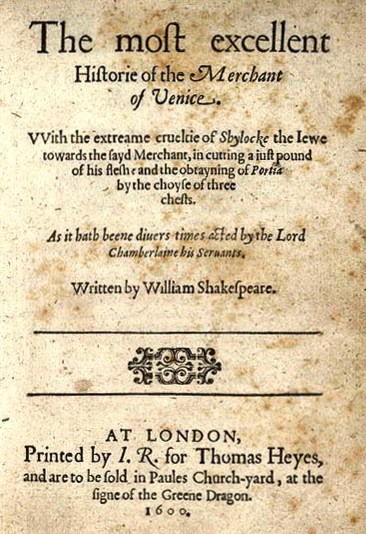
Shakespeare · Comedies
c. 1596–97
Comedy — from Ser Giovanni Fiorentino's Il Pecorone, with the casket story from the Gesta Romanorum
To fund his friend Bassanio's courtship of the heiress Portia, the merchant Antonio borrows from the moneylender Shylock and signs a bond forfeiting a pound of his own flesh. When Antonio's ships fail, Shylock — whose daughter has eloped with a Christian — demands the penalty in court, and Portia, disguised as a young lawyer, defeats him on a technicality. Listed with the comedies, it is now usually played as a problem play about prejudice and law.
'Hath not a Jew eyes? Hath not a Jew hands, organs, dimensions, senses, affections, passions?'
Shylock's speech in Act 3, arguing common humanity and the right to revenge
'The quality of mercy is not strained, / It droppeth as the gentle rain from heaven'
Portia, disguised as the lawyer Balthazar, in the trial scene
'All that glisters is not gold'
The scroll in the golden casket, found by the Prince of Morocco
'In sooth, I know not why I am so sad'
Antonio's opening line
A daughter elopes with a Christian, taking a turquoise ring given by her mother
Jessica leaves with Lorenzo and trades the ring for a monkey, to her father's grief
A court finds the bond valid but forbids the shedding of one drop of blood
Portia's ruling, which turns the penalty back on the plaintiff
'How sweet the moonlight sleeps upon this bank!'
Lorenzo to Jessica at Belmont in the final act, on the music of the spheres