🪴 GoDeep
Search
← University Challenge
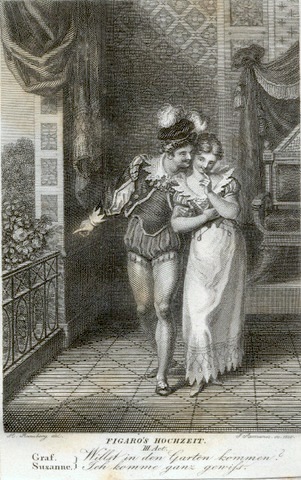
Portrait of The Marriage of Figaro

Opera · Italian opera

The Marriage of Figaro

1 May 1786, Burgtheater, Vienna

Wolfgang Amadeus Mozart · libretto by Lorenzo Da Ponte

Mozart's first collaboration with Da Ponte, an opera buffa in four acts drawn from Beaumarchais's banned comedy. Over one chaotic day in Count Almaviva's castle near Seville, the barber-turned-valet Figaro and his bride Susanna outwit their employer, who is trying to seduce Susanna before their wedding night. It ends not in farce but in the Count's genuine plea for forgiveness and his Countess's quiet granting of it — the moment most listeners name as the greatest in comic opera.

How to spot them

  • ▸One mad day near Seville: a servant couple, a philandering count, a disguised page and a garden full of mistaken identities
  • ▸Voices: Figaro (bass-baritone), Susanna (soprano), the Count (baritone), the Countess (soprano), Cherubino (a boy sung by a mezzo-soprano — a trouser role)
  • ▸The pin, the letter dictated in a duet, and the Act II finale that keeps adding singers until there are seven onstage
  • ▸Clue patterns: Da Ponte, Beaumarchais, Burgtheater 1786, K. 492, 'Contessa, perdono'

Arias & moments — listen

Overture (Presto, D major) (1786)

Four minutes of whispering strings and sudden tuttis; no tune from the opera appears in it

Recording: Ferenc Fricsay, RIAS-Symphonie-Orchester, Renato Capecchi, Irmgard Seefried, Dietrich Fischer-Dieskau, Maria Stader, Hertha Töpper · Public domain, Wikimedia Commons

"Non più andrai, farfallone amoroso" (1786)

A valet mockingly packs a lovesick page off to the army; Mozart quoted it himself in Don Giovanni's supper scene

Recording: Ferenc Fricsay, RIAS-Symphonie-Orchester, Renato Capecchi, Irmgard Seefried, Dietrich Fischer-Dieskau, Maria Stader, Hertha Töpper · Public domain, Wikimedia Commons

"Non so più cosa son, cosa faccio" (1786)

The breathless aria of an adolescent page in love with every woman in the house

Recording: Ferenc Fricsay, RIAS-Symphonie-Orchester, Renato Capecchi, Irmgard Seefried, Dietrich Fischer-Dieskau, Maria Stader, Hertha Töpper · Public domain, Wikimedia Commons

"Porgi, amor, qualche ristoro" (1786)

A neglected wife's first entrance — she does not appear at all until Act II, and begins with this prayer

Recording: Ferenc Fricsay, RIAS-Symphonie-Orchester, Renato Capecchi, Irmgard Seefried, Dietrich Fischer-Dieskau, Maria Stader, Hertha Töpper · Public domain, Wikimedia Commons

"Voi che sapete che cosa è amor" (1786)

A canzonetta the page has written himself, sung to the Countess with Susanna at the guitar

Recording: Ferenc Fricsay, RIAS-Symphonie-Orchester, Renato Capecchi, Irmgard Seefried, Dietrich Fischer-Dieskau, Maria Stader, Hertha Töpper · Public domain, Wikimedia Commons

"Sull'aria… che soave zeffiretto" (the Letter Duet) (1786)

Two women dictate and write a forged love-note; the duet the prisoners hear in The Shawshank Redemption

Recording: Ferenc Fricsay, RIAS-Symphonie-Orchester, Renato Capecchi, Irmgard Seefried, Dietrich Fischer-Dieskau, Maria Stader, Hertha Töpper · Public domain, Wikimedia Commons

"Deh vieni, non tardar, o gioia bella" (1786)

A maid teases her hidden bridegroom with a love song he thinks is meant for the Count

Recording: Ferenc Fricsay, RIAS-Symphonie-Orchester, Renato Capecchi, Irmgard Seefried, Dietrich Fischer-Dieskau, Maria Stader, Hertha Töpper · Public domain, Wikimedia Commons

Quick-fire facts

  • •Music by Mozart (K. 492), libretto by Lorenzo Da Ponte, in Italian; the Italian title is Le nozze di Figaro.
  • •It premiered at the Burgtheater, Vienna, on 1 May 1786, conducted by Mozart from the keyboard.
  • •The source is Beaumarchais's play La folle journée, ou Le Mariage de Figaro, whose performance Emperor Joseph II had banned in Vienna as politically inflammatory; Da Ponte removed Figaro's attack on the aristocracy to get the opera licensed.
  • •It is the middle panel of the Beaumarchais Figaro trilogy: Rossini's The Barber of Seville is the prequel, with the same Count, Countess (Rosina) and Figaro.
  • •The Act II finale runs about twenty minutes of continuous music and builds from a duet to a seven-part ensemble without a break.
  • •Cherubino is a trouser role — an adolescent boy written for a woman's voice.
  • •The Vienna run was modest; the Prague production later that year was a sensation, which is why Mozart was commissioned to write Don Giovanni for Prague.
  • •Mozart later quoted 'Non più andrai' as table music in the final scene of Don Giovanni, where Leporello remarks that he knows the tune too well.
  • •The Count's 'Contessa, perdono' and her reply are often cited as the opera's emotional summit, arriving seconds before the curtain.

Drill it — 8 cards

1 / 8new card

Sources

  • Grove Music Online (Oxford Music Online) — Le nozze di Figaro Composition, licensing of the Beaumarchais source, and premiere details
  • Gustav Kobbé, rev. the Earl of Harewood and Antony Peattie — The New Kobbé's Opera Book Act-by-act synopsis and numbering of the musical items