The loss of Normandy, Anjou, Maine and Touraine to Philip Augustus, and with them most of the family's French inheritance (1204)
Château Gaillard fell in March 1204 and Rouen in June, earning him the nickname Softsword.
Monarchs · Plantagenet
1166–1216
House of Plantagenet — Lackland, and the collapse of the Angevin Empire
In office: 1199–1216
Youngest son of Henry II, John succeeded his brother Richard in 1199 and within five years had lost Normandy, Anjou and most of the Angevin lands in France. Quarrels with Innocent III brought a six-year interdict and his own excommunication, ended only by surrendering England as a papal fief in 1213. Heavy taxation and the failure of his French campaign at Bouvines in 1214 drove his barons to revolt, producing Magna Carta at Runnymede in June 1215. The charter failed as a peace, and John died in October 1216 with a French prince holding London.
The loss of Normandy, Anjou, Maine and Touraine to Philip Augustus, and with them most of the family's French inheritance (1204)
Château Gaillard fell in March 1204 and Rouen in June, earning him the nickname Softsword.
The disappearance of a sixteen-year-old nephew and rival claimant, last seen a prisoner at Rouen (1203)
Arthur of Brittany; contemporaries believed the king had killed him.
Six years of papal interdict, with churches shut, no bells rung and the dead buried in unconsecrated ground (1208–1214)
Imposed over the refusal to accept Stephen Langton as archbishop of Canterbury; the king was excommunicated in 1209.
The surrender of a kingdom to the Pope, taken back as a papal fief for a tribute of 1,000 marks a year (1213)
The submission to Innocent III turned the papacy into his strongest ally against the barons.
The defeat of his allies at Bouvines in Flanders, ending any hope of recovering the lost French lands (1214)
Otto IV and the count of Flanders were beaten by Philip Augustus on 27 July 1214.
A rebel baronage inviting the son of the king of France to take the English throne, and Londoners opening their gates to him (1216)
Prince Louis, later Louis VIII, landed in May 1216 and was proclaimed in London.
Baggage, treasure and, by tradition, the crown jewels lost to the incoming tide while crossing an East Anglian estuary (1216)
The Wash, October 1216; the story comes from Roger of Wendover.
Death of dysentery at Newark Castle days later, and burial at Worcester between the shrines of two saints (1216)
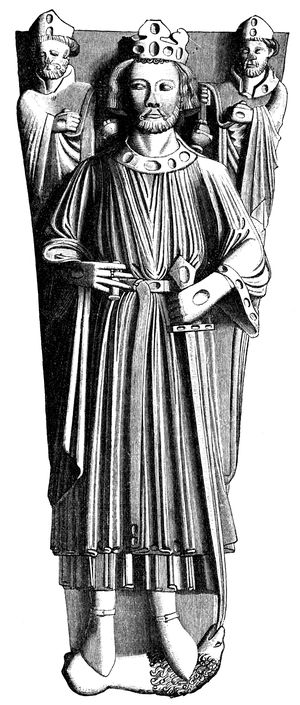
18/19 October 1216; his effigy at Worcester is the oldest royal effigy in England.