A disinherited duke landing at Ravenspur in Yorkshire in July 1399 to claim his father's confiscated lands (1399)
He came for the duchy of Lancaster and within three months had taken the crown instead.
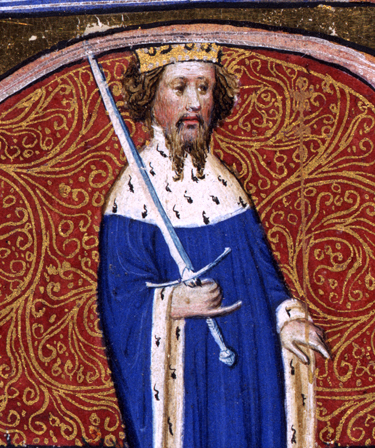
Monarchs · Lancaster & York
1367–1413
House of Lancaster — the usurper king
In office: 1399–1413
Henry Bolingbroke, son of John of Gaunt, was exiled by Richard II in 1398 and disinherited the following year. He returned while the king was in Ireland, took the throne, and spent almost his whole reign fighting to keep it: a Welsh revolt under Owain Glyndwr, three Percy rebellions, and an archbishop executed for treason. Chronically ill from 1405, he died in the Jerusalem Chamber at Westminster in 1413, and is the only English sovereign buried at Canterbury.
A disinherited duke landing at Ravenspur in Yorkshire in July 1399 to claim his father's confiscated lands (1399)
He came for the duchy of Lancaster and within three months had taken the crown instead.
A statute of 1401 that for the first time in England allowed obstinate heretics to be burned (1401)
De heretico comburendo, aimed at the Lollards; the priest William Sawtrey was the first to suffer under it.
A Welsh landowner's quarrel with a neighbour that became a national revolt and a self-proclaimed principality (1400–1415)
Owain Glyndwr, proclaimed Prince of Wales in September 1400; he held parliaments at Machynlleth and simply vanished after 1412.
A battle outside a Shropshire town in July 1403 where a famous northern warrior was killed by an arrow to the face (1403)
Shrewsbury; Sir Henry Percy, 'Hotspur', died there, and the sixteen-year-old Prince of Wales was wounded by an arrow.
A pact of 1405 to divide England and Wales three ways between a Welsh prince, a northern earl and a Mortimer (1405)
The Tripartite Indenture, agreed by Glyndwr, the Earl of Northumberland and Edmund Mortimer.
The execution of an Archbishop of York for rebellion in 1405, blamed thereafter for the king's disfiguring illness (1405)
Richard Scrope, beheaded outside York; unprecedented in England, and widely called sacrilege.
A king who was told he would die in Jerusalem, and did — in a chamber of that name at Westminster Abbey (1413)
He collapsed at the shrine of Edward the Confessor and was carried into the Abbot's Jerusalem Chamber.
The only English sovereign buried in the cathedral at Canterbury, near the shrine of Thomas Becket (1413)
He lies with Joan of Navarre; the tomb was opened in 1832 and the body found well preserved.