A throne set at the water's edge and an order to the incoming tide, staged to shame flattering courtiers (c. 1030)
Told by Henry of Huntingdon a century later: the point was that royal power is nothing beside God's.
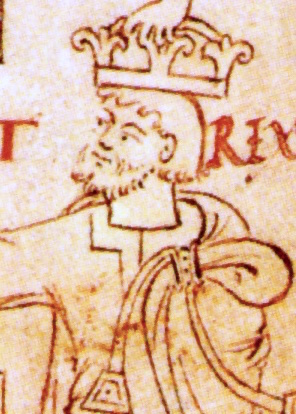
Monarchs · Anglo-Saxon & Danish
c. 990–1035
House of Denmark — the North Sea Empire
In office: 1016–1035
Son of Sweyn Forkbeard, Cnut won England by conquest in 1016, defeating Edmund Ironside at Assandun and taking the whole kingdom on Edmund's death. He married Æthelred's widow Emma of Normandy, added Denmark in 1018 and Norway in 1028, and ruled a North Sea empire from England. After a violent start he governed as a conventional Christian king: law codes drawn from English tradition, generous patronage of the Church, a pilgrimage to Rome in 1027, and a realm divided into great earldoms.
A throne set at the water's edge and an order to the incoming tide, staged to shame flattering courtiers (c. 1030)
Told by Henry of Huntingdon a century later: the point was that royal power is nothing beside God's.
Victory at Assandun in Essex, followed by a treaty at Olney dividing England with a rival who died within weeks (1016)
Edmund Ironside kept Wessex and died on 30 November 1016, leaving the whole kingdom to the Dane.
Marriage to the Norman-born widow of the previous English king, who had been queen already for fourteen years (1017)
Emma of Normandy; their son Harthacnut later ruled both England and Denmark.
A journey to Rome for an emperor's coronation, and a letter home promising English pilgrims relief from tolls (1027)
He attended the imperial coronation of Conrad II on Easter Day 1027.
Three crowns held at once — an island kingdom, plus Denmark and Norway (1028)
The North Sea Empire; he also claimed overlordship of part of Sweden.
The division of England into a handful of great earldoms, raising a Sussex thegn to rule Wessex (c. 1020)
Godwin, father of Harold II, became earl of Wessex.
Royal bones scattered by Parliamentarian soldiers and later gathered into mortuary chests above a Hampshire cathedral's choir (1642)
Winchester Cathedral; recent study of the chests has identified bones consistent with his and Emma's.