The speech to the South African parliament on 3 February 1960 about a wind blowing through the continent (1960)
Harold Macmillan's "wind of change" address in Cape Town.
History · The 20th century
1951–1994
The end of European empire on a continent, from Libya in 1951 to majority rule in 1994
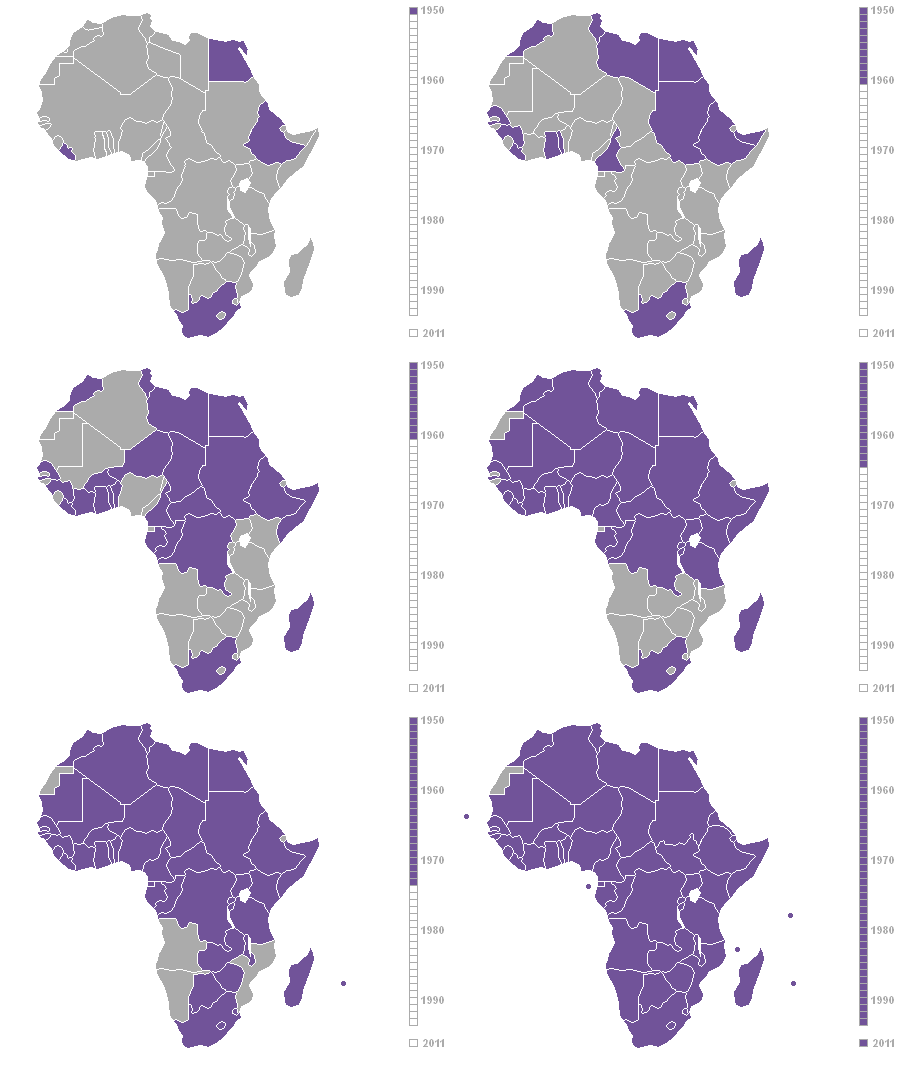
The dismantling of European colonial rule across a continent, compressed into a single generation. Libya became independent in 1951 and Ghana, in 1957, was the first colony in sub-Saharan Africa to follow; 1960, the Year of Africa, brought independence to seventeen states and gave Harold Macmillan the occasion for his "wind of change" speech in Cape Town. Some transfers were negotiated, as in Ghana, Nigeria and Tanganyika; others came only after long wars, as in Algeria, Kenya, the Portuguese territories and Zimbabwe. The new states kept, almost without exception, the borders drawn by the colonial powers, a principle the Organisation of African Unity affirmed in 1964.
The speech to the South African parliament on 3 February 1960 about a wind blowing through the continent (1960)
Harold Macmillan's "wind of change" address in Cape Town.
The former Gold Coast, independent on 6 March 1957 under Kwame Nkrumah (1957)
Ghana, the first colony in sub-Saharan Africa to gain independence.
The only territory to vote no in de Gaulle's 1958 community referendum, under Sékou Touré (1958)
Guinea, which was granted immediate independence and abruptly cut off by France.
The year in which seventeen states became independent, including Nigeria, Senegal and Madagascar (1960)
The Year of Africa.
The murder in January 1961 of a first prime minister who had taken office the previous June (1961)
Patrice Lumumba of the Congo, killed in Katanga amid the secession crisis.
The 1962 accords, signed in a spa town on Lake Geneva, that ended a war begun in 1954 (1962)
The Évian Accords, ending the Algerian War; Ahmed Ben Bella became the first president.
The Lisbon coup of April 1974 that led within eighteen months to independence for Angola and Mozambique (1974)
The Carnation Revolution, which ended Portugal's colonial wars.
The unilateral declaration of independence made by Ian Smith's government on 11 November 1965 (1965)
Rhodesia's UDI; majority rule came only with Zimbabwe's independence in 1980.