A boy takes his classmate's exercise book home by mistake and spends the evening climbing a zigzag path between two villages trying to return it (1987)
Where Is the Friend's House? — the first part of the Koker trilogy.
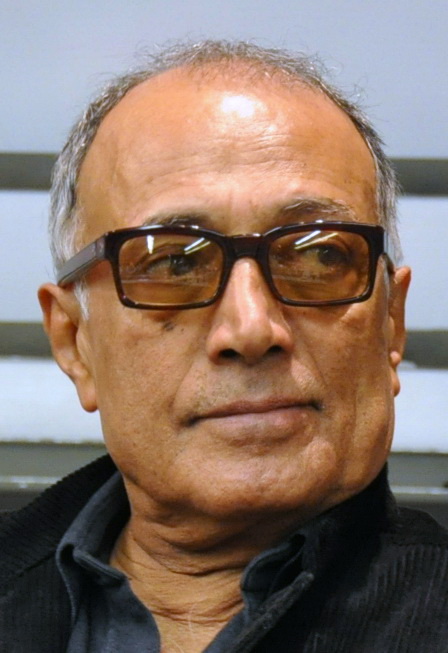
Film · Around the world
1940–2016 · Iranian
Iranian New Wave
Abbas Kiarostami made films that deliberately blur documentary and fiction: non-professional actors playing versions of themselves, cars used as mobile confessionals, endings withheld, and the apparatus of filmmaking left visible inside the film. Working within the constraints of the Islamic Republic, he became the figurehead of the Iranian New Wave and the first Iranian to win the Palme d'Or. He was also a photographer, poet and designer of his own film posters.
A boy takes his classmate's exercise book home by mistake and spends the evening climbing a zigzag path between two villages trying to return it (1987)
Where Is the Friend's House? — the first part of the Koker trilogy.
A man who impersonated a famous Iranian director to a family is tried for fraud, and plays himself in a reconstruction of it (1990)
Close-Up — the impostor was Hossain Sabzian, the director he impersonated Mohsen Makhmalbaf.
A director drives his son into the earthquake zone to find out whether the boy actors of his previous film survived (1992)
And Life Goes On — the middle of the Koker trilogy, made after the 1990 Manjil–Rudbar earthquake.
A man drives round the hills outside the capital asking strangers to do one thing for him: bury him in the morning if he is dead (1997)
Taste of Cherry — shared the Palme d'Or with Shohei Imamura's The Eel.
A film crew waits in a Kurdish village for an old woman to die so they can record the mourning ritual, and a doctor on a motorbike quotes Omar Khayyam (1999)
The Wind Will Carry Us — Grand Special Jury Prize at Venice; the title is from a poem by Forugh Farrokhzad.
Ten conversations in a Tehran car, shot entirely on two dashboard-mounted digital cameras with no crew present (2002)
Ten — with Mania Akbari driving.
An English writer and a French antiques dealer in Tuscany spend an afternoon behaving as though they have been married for fifteen years (2010)
Certified Copy — Juliette Binoche won Best Actress at Cannes; his first fiction feature shot outside Iran.
A retired Tokyo academic hires a student escort and is mistaken for her grandfather (2012)
Like Someone in Love — his last completed feature, made in Japan.