
A Harlot's Progress (1731–1732)
Paintings destroyed by fire in 1755; engravings survive
Six scenes following Moll Hackabout from country girl to death in poverty; his first moral series
Image: William Hogarth · CC0, Wikimedia Commons

Art
1697–1764 · English
Rococo / Satirical art
William Hogarth was a London painter and engraver whose satirical "modern moral subjects" — narrative series such as A Rake's Progress and Marriage A-la-Mode — mocked the vices of Georgian society. Sold as popular prints, they made him famous and led to the first copyright law protecting artists. "Hogarthian" now describes scenes of teeming, squalid, comic urban life.
A Harlot's Progress (1731–1732)
Paintings destroyed by fire in 1755; engravings survive
Six scenes following Moll Hackabout from country girl to death in poverty; his first moral series
Image: William Hogarth · CC0, Wikimedia Commons

A Rake's Progress (1732–1734)
Sir John Soane's Museum, London
Eight scenes of Tom Rakewell's squandered inheritance, ending in Bedlam; inspired Stravinsky's opera
Image: Unknown · Public domain, Wikimedia Commons

Marriage A-la-Mode (c. 1743)
National Gallery, London
Six scenes of a loveless arranged marriage between an earl's son and a merchant's daughter
Image: William Hogarth · Public domain, Wikimedia Commons
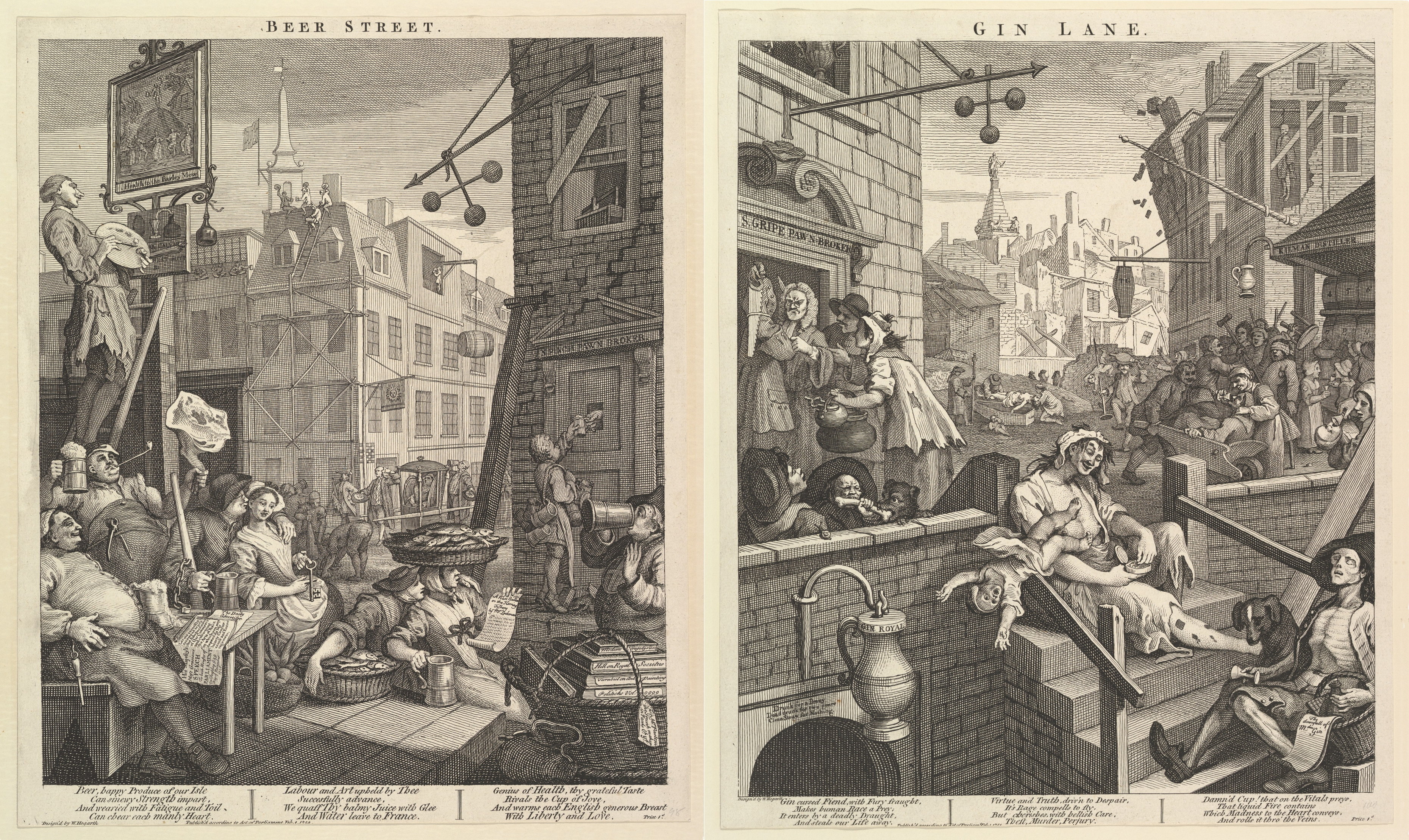
Beer Street and Gin Lane (1751)
Prints (impressions in the British Museum and elsewhere)
Paired prints contrasting healthy beer-drinkers with gin-sodden ruin in St Giles; a baby falls from its mother's arms
Image: William Hogarth · Public domain, Wikimedia Commons

The Gate of Calais (O the Roast Beef of Old England) (1748)
Tate Britain, London
Anti-French satire of a huge side of beef carried past starving soldiers; Hogarth drew himself sketching at left
Image: William Hogarth · Public domain, Wikimedia Commons
The Painter and his Pug (1745)
Tate Britain, London
Self-portrait on a canvas propped on volumes of Shakespeare, Milton and Swift, beside his pug Trump and the 'line of beauty'
No free image available (likely still in copyright) · see it on Wikipedia