🪴 GoDeep
Search
← University Challenge
Portrait of Ai Weiwei

Art · 21st century

Ai Weiwei

born 1957 · Chinese

Conceptual art and activism

Ai Weiwei is the best-known Chinese artist alive and the most prominent critic of his own government. He smashes Han dynasty urns, carpets galleries with handmade porcelain seeds, builds monuments from the wreckage of an earthquake, and treats his own surveillance, beating and 81-day detention as material. He has worked in exile from Europe since 2015.

How to spot them

  • ▸Traditional Chinese craft turned against itself: Ming furniture rebuilt into impossible shapes, ancient pots dipped in car paint
  • ▸Enormous numbers of handmade identical units — 100 million porcelain seeds, thousands of schoolchildren's backpacks, tonnes of straightened rebar
  • ▸The artist himself in the work: raising a middle finger at monuments, documenting his own arrest, re-enacting his detention
  • ▸Refugee subject matter from 2015 on: lifejackets, inflatable boats, the film Human Flow

Key works

A hundred million porcelain husks, each moulded, fired and hand-painted in Jingdezhen, poured across a former power station's hall by Ai Weiwei

A hundred million porcelain husks, each moulded, fired and hand-painted in Jingdezhen, poured across a former power station's hall (2010)

Turbine Hall, Tate Modern, London

Kui Hua Zi (Sunflower Seeds); visitors were soon barred from walking on it because of ceramic dust

Image: Photograph by Mike Peel ( www.mikepeel.net ). · CC BY-SA 4.0, Wikimedia Commons

Three photographs of the artist letting a two-thousand-year-old ceremonial vessel fall and shatter (1995)

Various collections

Endlessly parodied, and itself re-enacted by a visitor who smashed one of his painted urns in Miami in 2014

No free image available (likely still in copyright) · see it on Wikipedia

Twelve bronze animal heads reimagining the fountain-clock looted from the Old Summer Palace in 1860 by Ai Weiwei

Twelve bronze animal heads reimagining the fountain-clock looted from the Old Summer Palace in 1860 (2010)

Touring; versions in numerous public collections

The original heads were taken from the Yuanmingyuan by Anglo-French troops

Image: Amanda Slater from Coventry, West Midlands, UK · CC BY-SA 2.0, Wikimedia Commons

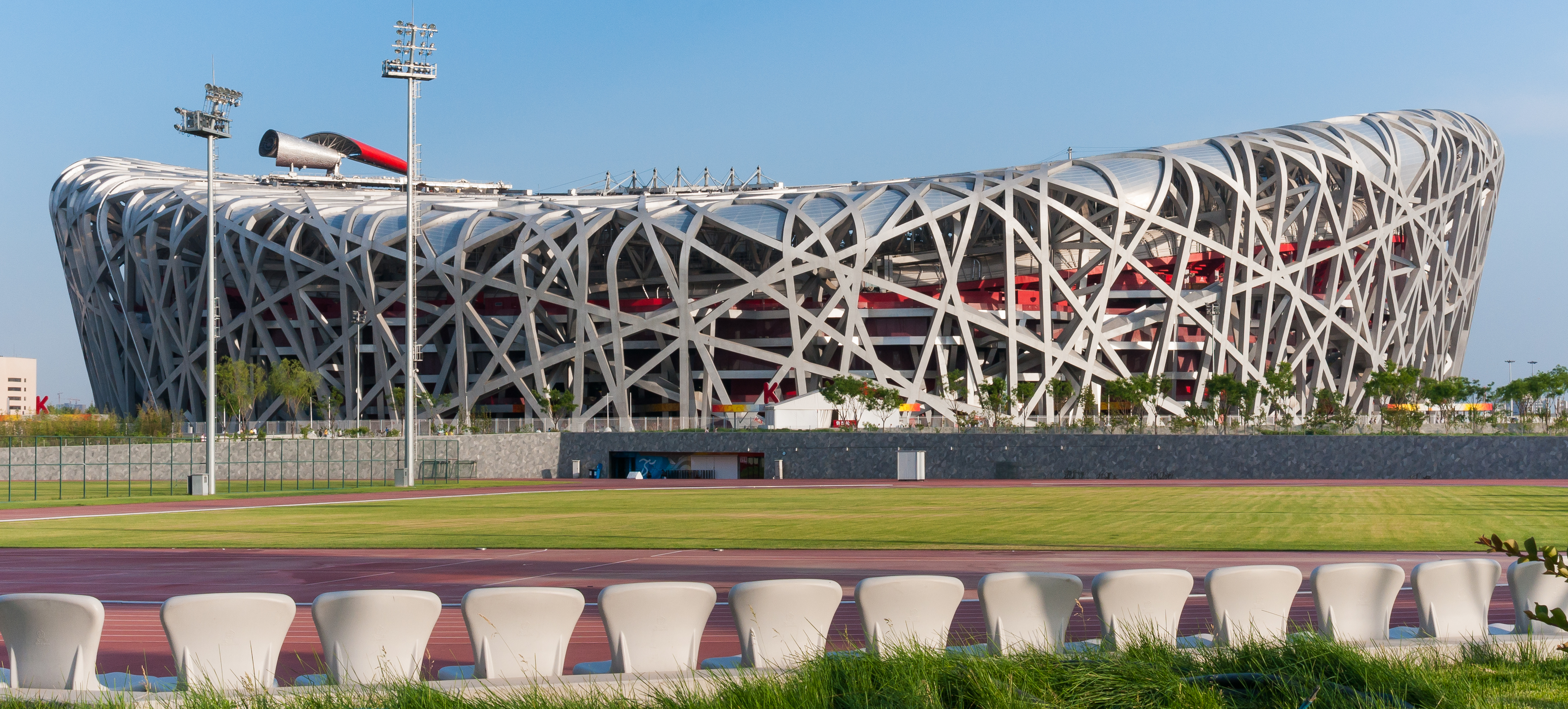
A lattice of steel around a Beijing arena, designed with a Swiss firm for the 2008 Olympics and later disowned by its Chinese collaborator by Ai Weiwei

A lattice of steel around a Beijing arena, designed with a Swiss firm for the 2008 Olympics and later disowned by its Chinese collaborator (2008)

Beijing, China

The Bird's Nest, with Herzog & de Meuron; he refused to attend the opening ceremony

Image: CEphoto, Uwe Aranas · CC BY-SA 3.0, Wikimedia Commons

Ninety tonnes of reinforcing bar salvaged from collapsed schools and hammered straight again, laid out in a fault-line ripple (2012)

Various collections and exhibitions

Straight, made after the 2008 Sichuan earthquake

No free image available (likely still in copyright) · see it on Wikipedia

A façade covered with nine thousand children's backpacks spelling out a bereaved mother's words in Chinese (2009)

Haus der Kunst, Munich (temporary)

'She lived happily for seven years in this world' — a mother of a child killed in the Sichuan earthquake

No free image available (likely still in copyright) · see it on Wikipedia

Quick-fire facts

  • •Born in Beijing in 1957, the son of the poet Ai Qing, who was denounced and exiled with his family to labour camps in Xinjiang
  • •Lived in New York from 1981 to 1993, photographing the East Village and absorbing Duchamp and Warhol
  • •Co-founded the Beijing East Village artists' community and, in 2003, worked as artistic consultant to Herzog & de Meuron on the Bird's Nest stadium
  • •Ran a citizen investigation into the schoolchildren killed by shoddily built schools in the 2008 Sichuan earthquake, compiling over 5,000 names
  • •Beaten by police in Chengdu in 2009, he needed emergency surgery in Munich for a cerebral haemorrhage
  • •His Shanghai studio was demolished by the authorities in 2011
  • •Detained without charge for 81 days in 2011 and later presented with a tax bill of about 15 million yuan, much of it paid by public donations
  • •Got his passport back in 2015 and has since lived in Berlin, then Britain and Portugal; his refugee documentary Human Flow appeared in 2017
  • •In 2026 he filled Aviva Studios in Manchester with Button Up! and re-enacted his detention in a 24-hour performance

Drill it — 8 cards

1 / 8new card

Sources