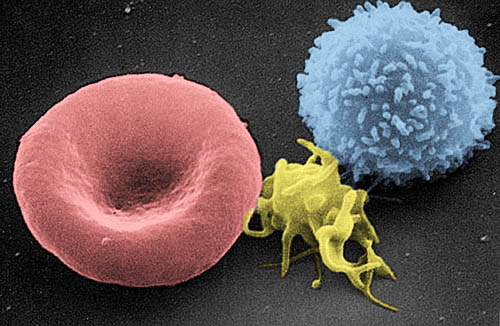
A biconcave disc about 7–8 micrometres across with no nucleus
Red blood cell — the erythrocyte.
Anatomy · Cells & tissues
The most numerous cell in the body
Blood · formed element
The oxygen-carrying cell of the blood: a flexible biconcave disc about 7–8 micrometres across, with a thin pale centre. In humans it has thrown out its nucleus and most organelles, leaving room for haemoglobin, the iron-containing red protein that binds oxygen in the lungs and releases it in the tissues. Red cells make up about 45% of the blood's volume and are made in red bone marrow at more than two million a second, lasting around 120 days before the spleen removes them.
A biconcave disc about 7–8 micrometres across with no nucleus
Red blood cell — the erythrocyte.
Each holds some 270–300 million copies of an iron-containing protein that binds four oxygen molecules
Red blood cell — haemoglobin.
Made in the marrow at more than two million a second, under the control of a hormone from the kidney
Red blood cell — erythropoietin (EPO) drives erythropoiesis.
Removed after about 120 days by macrophages in the spleen and liver
Red blood cell — the iron is recycled, the rest becomes bilirubin.
First seen under the microscope by Jan Swammerdam in 1658 and described in detail by Antonie van Leeuwenhoek (1658)
Red blood cell — the earliest microscopic descriptions of blood corpuscles.
A single change to one amino acid in its main protein can distort it into a crescent shape that blocks capillaries
Red blood cell — sickle cell disease, from an altered beta-globin chain.
Its surface carries the A and B antigens that define the ABO blood groups
Red blood cell — the ABO antigens are on the red cell membrane.