🪴 GoDeep
Search
← University Challenge
Portrait of Phalanges

Anatomy · Bones

Phalanges

The finger and toe bones

Hand and foot · digits

The phalanges are the bones of the fingers and toes. There are 14 in each hand and 14 in each foot, 56 in the whole body: the thumb and the big toe have two each (proximal and distal), and every other digit has three (proximal, middle and distal). The name is from the ancient Greek phalanx, a tight block of soldiers.

How to spot them

  • ▸Small long bones in a row in each finger and toe: proximal, middle and distal
  • ▸Thumb and big toe have only two phalanges; the other eight digits have three
  • ▸Each has a base, shaft and head; the head is pulley-shaped for the hinge-like interphalangeal joint
  • ▸The distal phalanx of each finger ends in a flattened tuft supporting the pad and nail bed

What to know

Fourteen small long bones in each hand, two in the thumb and three in each of the other digits

Phalanges — the finger bones.
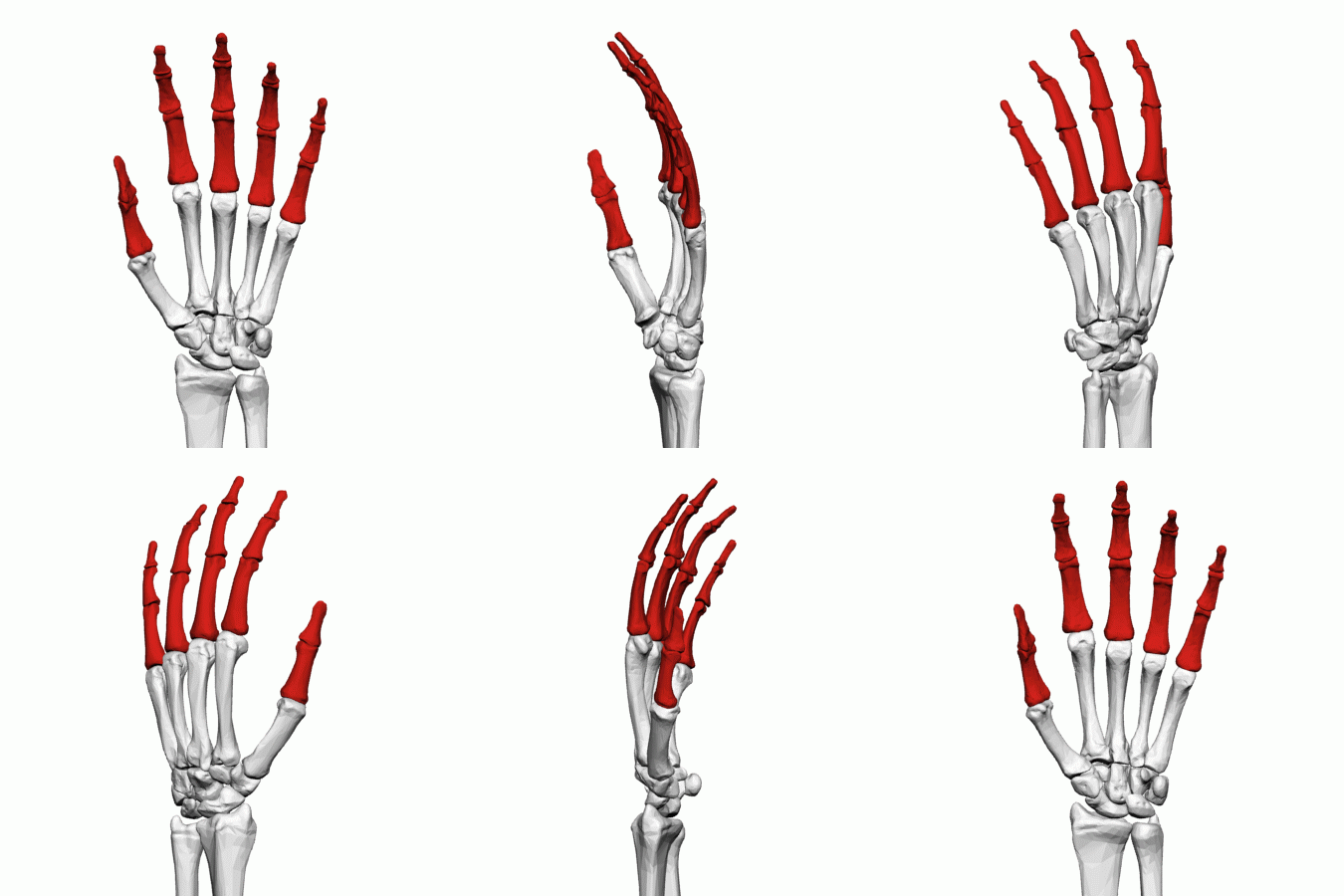
Their name comes from an ancient Greek battle formation, a tightly packed rectangular block of soldiers

Phalanges — from the Greek phalanx (singular phalanx).

Fifty-six of the 206 bones in the body, more than a quarter of the skeleton

Phalanges — 14 in each hand and 14 in each foot.

Each has a base, a shaft and a pulley-shaped head, and adjacent ones meet at hinge joints that flex and extend only

Phalanges — the interphalangeal joints.

A ball hitting the tip of the finger can avulse the extensor tendon from the base of the last one, leaving the fingertip drooping in 'mallet finger'

Phalanges — the distal phalanx.

The only digits with two of these bones are the thumb and the big toe

Phalanges — the pollex and the hallux have proximal and distal phalanges only.

Rounding of the fingertips with swelling of the ends of the digits, 'clubbing', involves the terminal ones

Phalanges — the distal phalanges.

Key ideas

  • Because the thumb has only two phalanges but a mobile first metacarpal, it works as a two-jointed lever on a mobile base; the other fingers are three-jointed levers on a fixed base.
  • Each finger has a proximal (PIP) and a distal (DIP) interphalangeal joint; the thumb has a single interphalangeal joint.

Quick-fire facts

  • •There are 14 phalanges in each hand and 14 in each foot: 56 in the body.
  • •The thumb (pollex) and big toe (hallux) each have two phalanges; digits 2 to 5 each have three.
  • •Phalanx (plural phalanges) is Greek for a battle line or block of soldiers, in reference to the rows of bones.
  • •The distal phalanges of the lesser toes are among the smallest bones of the body after the ear ossicles; the smallest of all is the stapes of the middle ear.
  • •Mallet finger is an avulsion of the extensor tendon at the distal phalanx; jersey finger is rupture of the flexor digitorum profundus tendon from the same bone, classically in rugby tackling.
  • •Each finger is made of a proximal, middle and distal phalanx; the joints between them are the proximal and distal interphalangeal joints.
  • •The metacarpophalangeal joints are the knuckles; the interphalangeal joints are hinges.
  • •The phalanges of the toes are much shorter than those of the fingers, apart from the big toe's.

Drill it — 7 cards

1 / 7new card

Sources