A tongue-shaped gland behind the stomach, its head cradled by the C of the duodenum and its tail reaching the spleen
Pancreas — from the Greek for 'all flesh'.
Anatomy · Organs & viscera
About 12 to 15 cm long, retroperitoneal
Upper abdomen · digestive and endocrine system
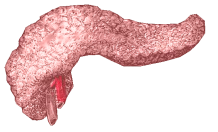
The pancreas is a long, tongue-shaped gland lying across the back of the upper abdomen, behind the stomach, at about the level of L1 to L2. Its head is nestled in the C of the duodenum, its body crosses in front of the aorta and left kidney, and its tail reaches the hilum of the spleen. It is both an exocrine gland, making digestive enzymes, and an endocrine gland, whose islets of Langerhans make insulin and glucagon.
A tongue-shaped gland behind the stomach, its head cradled by the C of the duodenum and its tail reaching the spleen
Pancreas — from the Greek for 'all flesh'.
A hook-shaped extension of its head that passes behind the superior mesenteric vessels
The uncinate process of the pancreas.
Its neck lies in front of the point where the superior mesenteric and splenic veins join to form the portal vein
The neck of the pancreas.
Islands of endocrine cells scattered through it, discovered by a German medical student in 1869
The islets of Langerhans in the pancreas, found by Paul Langerhans.
A tumour at its head often first shows as painless jaundice because it squeezes the bile duct
Pancreatic head cancer obstructing the common bile duct.
Its main duct joins the common bile duct to open on the major papilla of the duodenum
The main pancreatic duct (of Wirsung) of the pancreas.
Inflammation of this gland, often from gallstones or alcohol, causes severe upper abdominal pain that bores through to the back
Acute pancreatitis — the gland lies retroperitoneally behind the stomach.